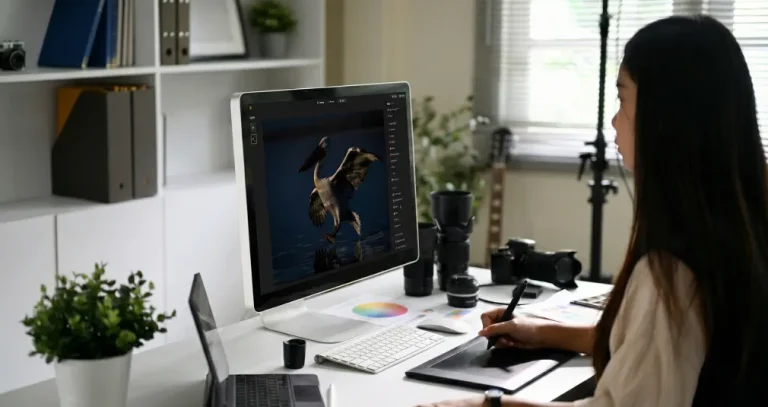
Is the Canon EOS R50 worth all the attention? Take a look at its specs, features, and price to see if this camera is right for you.
The official release date reshaped expectations for entry-level gear, narrowing the gap between casual photography and professional-grade content. The creators of the Canon EOS R50 focused on artificial intelligence that can instantly recognize and anticipate movement within the frame. Weighing just over 300 grams, the camera can replace an entire bag of equipment, handling difficult lighting and complex motion without operator input. In the Canon R50 review below, we examine the main updates and discuss alternative options.
Don’t feel like reading the whole breakdown right now? Here’s a tighter, more practical summary of what actually changed.
Key Takeaways
- Automation drives the user experience: Built-in artificial intelligence recognizes movement and adjusts settings automatically, reducing the need for manual shutter speed or aperture adjustments.
- Ultra-lightweight design replaces bulky gear: Weighing around 375 grams, the highly portable body retains a pronounced right-hand grip for balance with zoom lenses.
- Video quality benefits from high-resolution downsampling: The camera delivers uncropped 4K video at 30 frames per second, which is downsampled from 6K to provide higher clarity and less digital noise.
- Autofocus system rivals higher-end models: Dual Pixel CMOS AF II tracks subjects across 651 metering zones, efficiently detecting eyes and body contours even in low-light conditions.
- Burst shooting captures fast action seamlessly: Users can shoot up to 12 frames per second with the mechanical shutter or switch to electronic mode for 15 frames per second to freeze rapid motion.
- Cloud integration speeds up post-processing: Neural Network Image Processing enables instant cloud uploads right after capture, streamlining file transfers for raw image editing.
- Touch-first interface simplifies operation: The vari-angle screen acts as a large touchpad for focus adjustments, letting operators change core settings in seconds via the Q menu.
Overview of the Canon EOS R50
The Canon EOS R50 marks the end of the compact mirrorless EOS M line, which had long been seen as a standard for beginners. The engineering team carried over years of development into a new RF-mount system while keeping the body exceptionally lightweight.

The camera serves as the most accessible entry point into the brand’s current ecosystem, delivering flagship-level processing in a device that fits in the palm of your hand.
The design centers on automation, reducing the need for manual adjustments like shutter speed or aperture. The internal menu includes visual prompts that guide users through composition and lighting in real time, even during casual shooting.

The camera can produce RAW files with a large amount of retained data. This makes it easier to correct overexposed or underexposed areas during post-processing. The high quality of the original image raises the standard for retouch photo, making edits more precise and controlled.
Edits no longer compromise natural skin texture or fine details. The camera supports Neural Network Image Processing, enabling images to be uploaded to the cloud immediately after capture. If you use photo editors such as Luminar Neo, this helps streamline file transfer.
Your AI-Powered Photo Editor for MacOS and Windows
Core Features and Specifications

The internal hardware of the Canon EOS R50 closely mirrors the capabilities found in more expensive models, positioning this camera as a capable tool within a compact body. At the core is a 24.2-megapixel APS-C sensor paired with the DIGIC X processor. In a YouTube video, well-known blogger Kai Wong noted that this combination delivers detail comparable to cinematic footage.
The video performance stands out with true 4K resolution at 30 frames per second without any crop. The image is created through downsampling from 6K, which gives the footage a sharp and layered look. For those interested in creative effects, the camera supports 120 fps recording in Full HD, turning ordinary motion into smooth slow-motion video.
The OLED electronic viewfinder, with a resolution of 2.36 million dots, reproduces natural colors and maintains clear framing even in bright sunlight. The system can focus in low-light conditions, detecting subjects where the human eye sees only shadows. The body remains lightweight, yet still includes a port for an external microphone. The LP-E17 battery, rated at 1040 mAh, provides enough power for approximately 440 shots or several extended vlogging sessions.
Image Quality and Sensor Performance

The 24-megapixel APS-C image sensor captures fine detail while preserving depth and spatial dimension. Updated specs produce natural transitions between light and shadow, preventing flat gray areas in the image. The processor handles each pixel with precision, so evening shots remain free of color noise, while textures stay crisp and clearly defined.
The physical size of the sensor creates a soft background blur without relying on software effects. A wide dynamic range preserves color information even in challenging conditions, where bright sunlight meets deep shadows. The resulting files respond well to color correction, allowing a standard image to evolve into a polished visual with rich and accurate tones.
Autofocus and Shooting Speed
The Dual Pixel CMOS AF II system uses 651 metering zones to track subjects across the entire sensor. The camera quickly detects eyes and body contours, maintaining focus even during active movement. To reduce errors to a minimum, use the Canon R50 photography regardless of the shooting conditions.
The mechanical shutter delivers up to 12 frames per second, while switching to the electronic mode increases the speed to 15 shots. This allows moments such as water splashes, sparks from metal friction, or birds in motion to be captured with precision. Selecting the right frame out of thousands exceeds human capability, so the built-in algorithms handle this task efficiently.
Design, Build, and Handling

The 375-gram body makes the camera one of the lightest in the APS-C segment, turning it into a practical tool for reportage work. The engineers retained a pronounced grip for the right hand, maintaining balance when using zoom lenses. Published Canon EOS R50 reviews confirm the durability of the vari-angle screen hinge, which holds up under frequent use when shooting from sharp angles.
The top panel features a mode selector and a control dial positioned with hand ergonomics in mind, enabling quick shutter adjustments. The interface is designed so the operator spends only seconds changing core settings through the Q menu. The screen functions like a large touchpad, letting you move the focus point with your finger without taking your eye off the viewfinder.
Since ISO and white balance need to be adjusted more frequently than other settings during shooting, Canon engineers chose to present them as dedicated virtual buttons. In practical terms, there is no need to scroll through the entire menu to find the right options. A few swipes are enough to adapt the camera to changing shooting conditions.
Achieve Retro Chic with the Cross Processing Effect
Battery Life and Storage Options
The LP-E17 battery has enough capacity for a photo session during a walk, covering several walls of photos, or for recording an hour-long review. However, the power consumption of the DIGIC X processor requires careful attention to battery life, particularly when recording 4K video. For file storage, there is a single slot for high-speed UHS-I SD cards, providing stable data recording and convenient subsequent raw image editing on a computer.
Comparison with Other Entry-Level Mirrorless Cameras

For people with no experience, choosing a mirrorless camera comes down to two factors: ease of use and price. Most users don’t need a high-end model capable of producing cinematic-quality footage. They simply want a reliable tool they can use on the spot to capture moments with family and friends.
In the budget segment, performance and build quality are often at odds with one another. For most companies, it’s practically impossible to balance these two factors at a roughly equal, satisfactory level.
That’s why the Canon EOS R50 was marketed to potential buyers as a first step beyond a smartphone, aimed at beginners. It’s a moderately advanced yet reliable and affordable solution that almost any photographer can afford. But is it the best option in the segment?
| Model | Sensor | Max ISO | Continuous Shooting | Video Resolution |
| Canon EOS R50 | 24.2 MP APS-C | 32,000 | 15 fps | 4K 30p (6K Oversampled) |
| Sony ZV-E10 | 24.2 MP APS-C | 32,000 | 11 fps | 4K 30p |
| Nikon Z30 | 20.9 MP APS-C | 51,200 | 11 fps | 4K 30p |
| Fujifilm X-T30 II | 26.1 MP APS-C | 12,800 | 20 fps | 4K 30p |
| Canon EOS R100 | 24.1 MP APS-C | 12,800 | 6.5 fps | 4K 24p (Cropped) |
What sets the Canon EOS R50 apart from competitors like the Sony ZV-E10 is the quality of its 4K video, which is produced by downsampling from 6K. The resulting signal offers higher clarity and less digital noise. The autofocus system in this model outperforms the Nikon Z30 by utilizing sensors across the entire sensor area, ensuring sharp focus even in the corners of the frame.
Exclusive Tools of Endless Possibilities in One Editor
A Technologically Advanced Standard for Creative Beginners

The Canon EOS R50 is exactly what a modern camera for everyday life should be: it isn’t weighed down by extra specifications, consistently gets the job done, and is easy to learn. This gadget weighs less than a half-liter bottle of water, yet it takes photos on par with professional-grade equipment.
Thanks to its autofocus system with built-in search algorithms, the camera automatically identifies subjects of interest in the frame and then adjusts the settings to the optimal level. Even those who have previously only taken photos with a smartphone can capture sharp and vibrant images with the Canon EOS R50.