Find the best drones for kids in 2026, from guarded toy models to beginner-friendly camera drones. Compare safe picks for different ages, flying environments, and skill levels.
Choosing a drone for a child is less about finding the most advanced camera and more about matching the aircraft to the young pilot’s age, coordination, and flying environment. For beginners, protected propellers, simple controls, replaceable parts, and close adult supervision matter far more than range or speed.
This guide compares practical options for indoor play, first-person-view practice, and family photography. It also explains which products are genuine toy drones and which are full camera drones that should be operated by an older teen or adult.
Don’t feel like reading the whole breakdown? We’ve pulled together a quick summary below.
Key Takeaways
A small toy drone with full propeller guards is usually the best starting point for a younger beginner.
A sub-250 g camera drone is not automatically a children’s toy or safe to use without supervision.
Manufacturer age guidance should take priority over broad age recommendations in roundup articles.
Altitude hold, one-button takeoff and low-speed modes shorten the learning curve, but they do not replace practice.
Short flight times are normal for toy drones, so bundles with two or three batteries offer better value.
Before an outdoor flight, an adult should check local airspace, registration, training, privacy, and operating rules.
Recommended by DJI for users aged 16+; no obstacle avoidance
Product availability, bundles, app compatibility, and specifications can vary by market. Check the current manufacturer listing and manual before buying.
How We Chose These Drones
The strongest beginner pick is not necessarily the model with the longest range or highest-resolution camera. We prioritized:
guards that reduce direct contact with the propellers;
stable, predictable controls;
low-speed or beginner-friendly flight modes;
readily replaceable propellers and batteries;
a realistic match between camera quality and price;
a clear use case for indoor practice, FPV learning, or family photography.
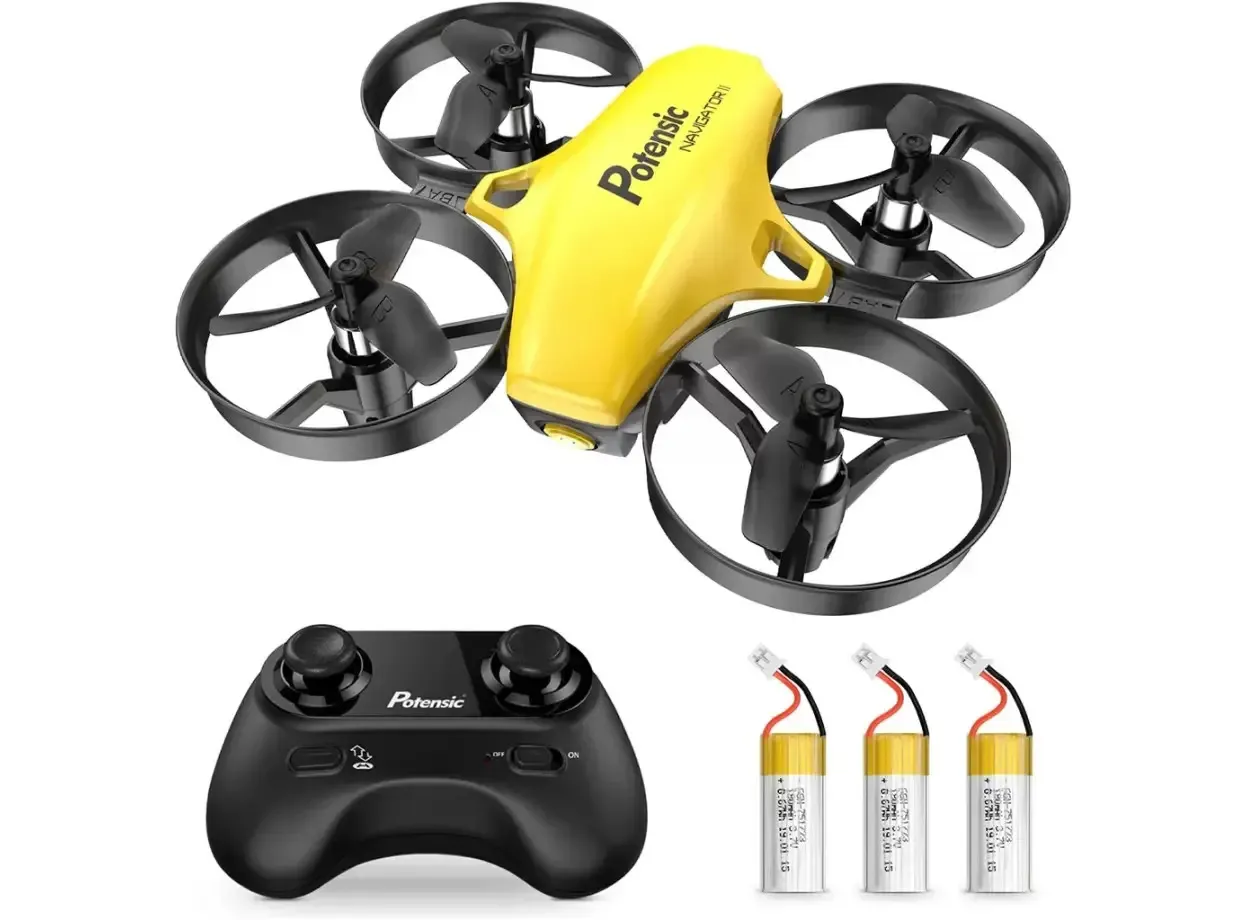
1. Potensic A20: Best Indoor Starter Drone
Best for: A younger beginner flying indoors with an adult nearby. Follow the age guidance printed on the current product package.
The Potensic A20 is a sensible first step for a child who has never used twin-stick controls. It is a compact, camera-free toy drone designed around basic flying rather than photography. Altitude hold, headless mode, and one-button takeoff and landing can make the first sessions less frustrating.
The propeller guards help protect both the aircraft and its surroundings, but they do not make contact risk-free. Begin in a clear indoor room, use the lowest speed setting, and keep faces, hair, pets, and fragile objects away from the flight area.
Pros
Cons
Compact enough for controlled indoor practice
No camera
Propeller guards
Short flight time per battery
Straightforward beginner controls
Too light for anything beyond very calm outdoor conditions
No phone or app needed for basic flight
2. Holy Stone HS210: Best Budget Toy Drone
Best for: Families seeking an inexpensive practice drone rather than a camera drone.
The Holy Stone HS210 is another camera-free mini drone focused on learning the controls. Common bundles include multiple batteries, which is useful because small toy drones usually fly for only a few minutes before they need a recharge.
Features such as altitude hold, headless mode, and one-key takeoff and landing make it approachable. It is still important to learn what each stick does rather than relying entirely on automated functions. Its low weight also means that drafts and outdoor wind can move it quickly.
Pros
Cons
Beginner-oriented controls
No camera
Guarded propellers
Easily affected by wind
Multi-battery bundles are commonly available
Exact battery count and accessories vary by seller
Suitable for indoor practice
3. BETAFPV Cetus Lite FPV Kit: Best First FPV Experience
Best for: An older child or teen specifically interested in FPV, with hands-on adult supervision.
FPV flying lets the pilot see the drone’s camera feed through goggles, creating a more immersive experience than line-of-sight toy flying. A ready-to-fly Cetus kit packages the microdrone, controller, goggles, and required accessories together, making it easier to understand what is needed to begin.
FPV is not the easiest first form of flying. Start with a compatible simulator where possible, then practise in a large, obstacle-free indoor area with an adult acting as a visual observer. Check the exact Cetus version before purchase because BETAFPV has released several similarly named kits with different features.
Pros
Cons
Complete FPV starter package
Short flight time per battery
Ducted microdrone design
Goggles can reduce awareness of people and objects nearby
Game-controller-style transmitter
The available Cetus version and included components may vary
Useful path into simulator practice and FPV skills
Exclusive Tools of Endless Possibilities in One Editor
4. HOVERAir X1: Best for Adult-Operated Family Follow Shots
Best for: Family videos controlled by an adult, with children participating as subjects rather than unsupervised pilots.
The HOVERAir X1 is better described as a compact self-flying camera than a children’s toy. Its enclosed propellers and automatic modes make it convenient for family walks and hands-free clips, while the camera records up to 2.7K video.
That automation should not be mistaken for complete autonomy. An adult should select the flight mode, inspect the surroundings, monitor the aircraft, and follow the current instructions for takeoff and landing. Tracking can fail when lighting, contrast, obstacles, or the environment make the subject difficult to detect.
Pros
Cons
Enclosed propeller design
More expensive than a toy drone
Automatic follow and preset filming modes
Limited flight time compared with larger camera drones
Compact and highly portable
Automated tracking is not a substitute for supervision or obstacle awareness
No traditional controller required for its core automatic modes
5. DJI Neo: Best Camera Drone for Older Teens
Best for: A responsible teen aged 16 or older who wants to learn aerial video with active adult involvement.
The DJI Neo is the strongest photography option in this list, but it belongs in a different class from inexpensive indoor toys. It weighs approximately 135 g, captures 12 MP JPEG photos and stabilized video up to 4K/30 fps, and offers palm takeoff plus several control methods. DJI lists the product as suitable for users aged 16 and above.
Its low weight and full-coverage propeller guards are helpful, but the Neo does not have obstacle avoidance. Outdoor flight therefore requires careful location selection, direct visual monitoring, and knowledge of local aviation rules. Actual flight time will also be shorter than the advertised laboratory maximum in many real conditions.
Pros
Cons
12 MP photos and stabilized 4K video
Intended for users aged 16+
Approximately 135 g takeoff weight
No obstacle avoidance
Full-coverage propeller guards
Costs substantially more than a basic toy drone
Automatic shooting modes and multiple control options
Some control methods and features require a phone or additional accessories
Which Type of Drone Is Right for Your Child?
Choose a toy drone when…
this is the child’s first experience with a remote-controlled aircraft;
most flights will take place indoors;
learning coordination matters more than recording video;
crashes are likely and inexpensive replacement parts are a priority.
Choose an FPV kit when…
the child already understands basic drone controls;
they are specifically interested in immersive piloting;
an adult can supervise and act as a visual observer;
there is enough room to practise safely or access to a simulator.
Choose a camera drone when…
the user meets the manufacturer’s age recommendation;
an adult understands the applicable flight and privacy rules;
image quality is more important than toy-like durability;
the family is prepared for the higher cost of batteries, accessories, and repairs.
For a broader introduction to flight features, see our guide to the best drones for beginners. Families planning to shoot away from home can also compare the best travel drones.
What to Look for in a Drone for Kids
1. Manufacturer Age Guidance
There is no single safe starting age for every drone. A protected indoor toy and a GPS-equipped outdoor camera drone involve very different levels of speed, responsibility, and regulation. Treat the manufacturer’s stated minimum age as the baseline, then consider the individual child’s coordination and judgment.
2. Propeller Protection
For first flights, choose a model with fixed guards or ducts around the propellers. Guards reduce the chance of direct contact and often limit damage in a light collision. They do not make it safe to fly near faces, loose hair, crowds, or animals.
3. Predictable Controls
Altitude hold, low-speed modes, one-button takeoff, and an emergency stop can help a beginner. Headless mode may simplify orientation initially, but learning the drone’s true front and rear builds better long-term piloting habits.
4. Indoor or Outdoor Performance
Very light toy drones are easiest to manage indoors and in still air. Outdoor camera drones need enough stability for the intended conditions, but no compact model should be flown when the wind exceeds its documented limit.
5. Battery and Spare-Part Availability
Compare flight time per battery, not only the combined time advertised for a multi-battery bundle. Check whether replacement batteries, propellers, guards, and charging cables are available from a reliable source.
6. Camera Expectations
Low-cost toy-drone cameras are primarily for fun. They often lack a stabilized gimbal and may produce soft, shaky video with limited dynamic range. If photography is the main goal, an older teen will get much better results from a true camera drone used responsibly.
Essential Drone Safety Rules for Families
Before every flight:
Read the current manual and confirm the manufacturer’s age guidance.
Check the frame, guards, propellers, and battery for damage or swelling.
Tie back long hair and keep fingers, faces, pets, and bystanders away from moving propellers.
Start in a clear, well-lit area and use the lowest suitable speed mode.
Keep the drone within direct visual sight, even when using a phone screen or FPV goggles.
Never fly near airports, emergency operations, crowds, roads, or restricted locations.
Respect people’s privacy and ask permission before recording them or flying over private property.
Confirm the current aviation rules for the country and location before flying outdoors.
In the United States, recreational flyers must complete the free TRUST safety test and carry proof while operating. Recreational drones weighing 250 g or more must be registered, and other requirements may also apply depending on how and where the drone is used. Parents should verify the latest rules rather than relying on the drone’s weight alone.
Your AI-Powered Photo Editor for MacOS and Windows
Even a beginner can use Luminar to crop an aerial composition, correct exposure and color, reduce noise, or remove a small distraction. These edits can make a usable photo cleaner and more engaging, but software cannot restore detail that the camera never captured or fully fix severe motion blur.
For children and teens learning photography, keep the workflow simple:
Straighten the horizon and crop distracting edges.
Recover highlights carefully, especially in bright skies.
Adjust white balance and color without oversaturating grass or water.
Apply sharpening and noise reduction at a moderate level.
Compare the edit with the original before exporting.
The goal is to help the young photographer understand why an image works—not to hide every imperfection. Our guide to editing dramatic drone images offers more ideas for shaping light, color, and atmosphere in aerial shots.
Final Verdict
For a first-time younger pilot, the Potensic A20 or Holy Stone HS210 is the most practical place to begin because both focus on guarded indoor flight rather than ambitious camera features. The BETAFPV Cetus Lite is a more specialized choice for supervised FPV learning. The HOVERAir X1 works best as an adult-operated family camera, while the DJI Neo is the better creative tool for a responsible user aged 16 or older.
Whichever model you choose, match it to the manufacturer’s age guidance, begin slowly, and treat supervision and local flight rules as part of the hobby from day one.
Frequently Asked Questions
What is the best drone for a child who has never flown before?
A small camera-free indoor drone with full propeller guards, a low-speed mode, and altitude hold is usually the easiest starting point. The Potensic A20 and Holy Stone HS210 fit that use case, subject to the age guidance on the current package.
At what age can a child fly a drone?
There is no universal minimum age for all models. Follow the manufacturer’s recommendation and local law. DJI, for example, states that the Neo is suitable for users aged 16 and above, while some toy drones are marketed to younger users under adult supervision.
Does a child need a license or registration to fly a drone?
Requirements depend on the country, aircraft, and purpose of the flight. In the United States, recreational flyers must pass TRUST. Registration is generally required for recreational drones weighing 250 g or more, but weight is not the only rule to consider.
Is a drone under 250 g automatically safe for kids?
No. Lower weight may affect certain regulations and reduce impact energy, but spinning propellers, batteries, obstacles, traffic, privacy, and airspace still create risks. Age guidance and supervision remain essential.
Can children fly camera drones indoors?
Only if the manufacturer permits indoor operation and the space is large, clear, and controlled. Disable unsuitable return-to-home behavior where the manual recommends it, use propeller guards, and keep other people and pets out of the room.
Can Luminar improve photos from an inexpensive drone?
Luminar can improve composition, tone, color, noise, and perceived sharpness. It cannot create genuine detail that was not recorded or reliably repair heavily blurred footage, so good light and steady flight still matter.
Subscribe to know first
Our delivery owl will bring you our best deals and news about Skylum news.