A Blue Moon usually looks like any other full moon, but its relative rarity makes it an interesting photography opportunity. Here’s how to plan the shot, choose the right settings, and create a strong composition.
A Blue Moon is one of those astronomical events that sounds more unusual than it actually looks. Despite its name, the Moon doesn’t normally turn blue. Instead, the term describes a particular occurrence of a full moon.
There are two accepted definitions of a Blue Moon. A monthly Blue Moon is the second full moon in a calendar month, while a seasonal Blue Moon is the third full moon in a season that contains four full moons. Both events are relatively uncommon, making them interesting opportunities for night-sky photographers.
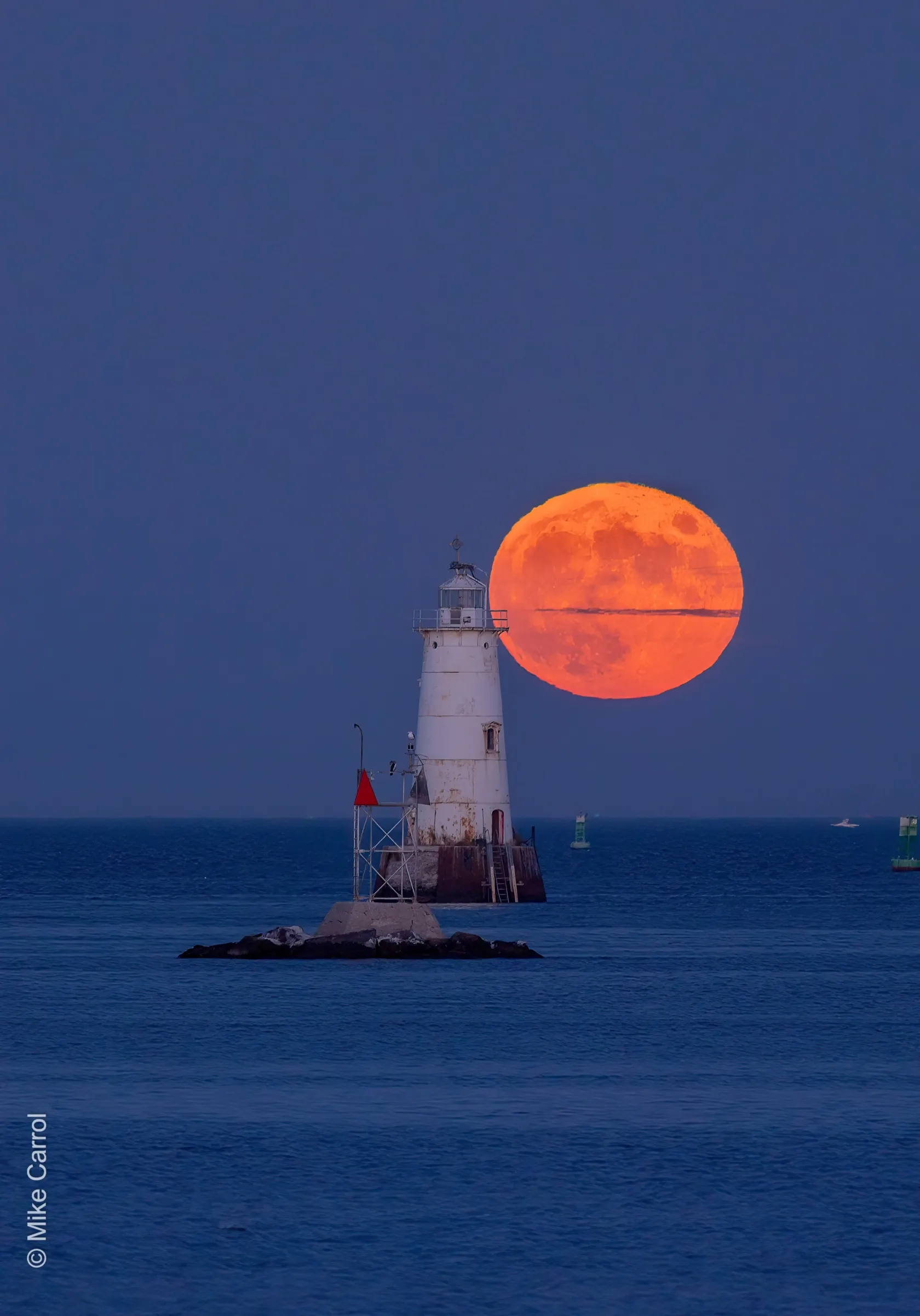
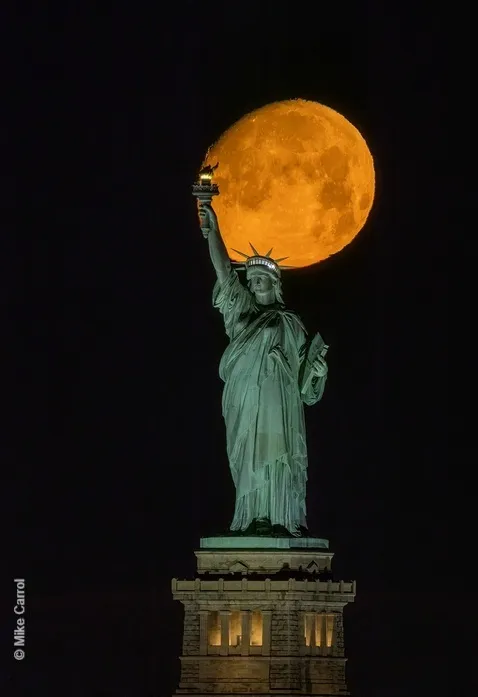
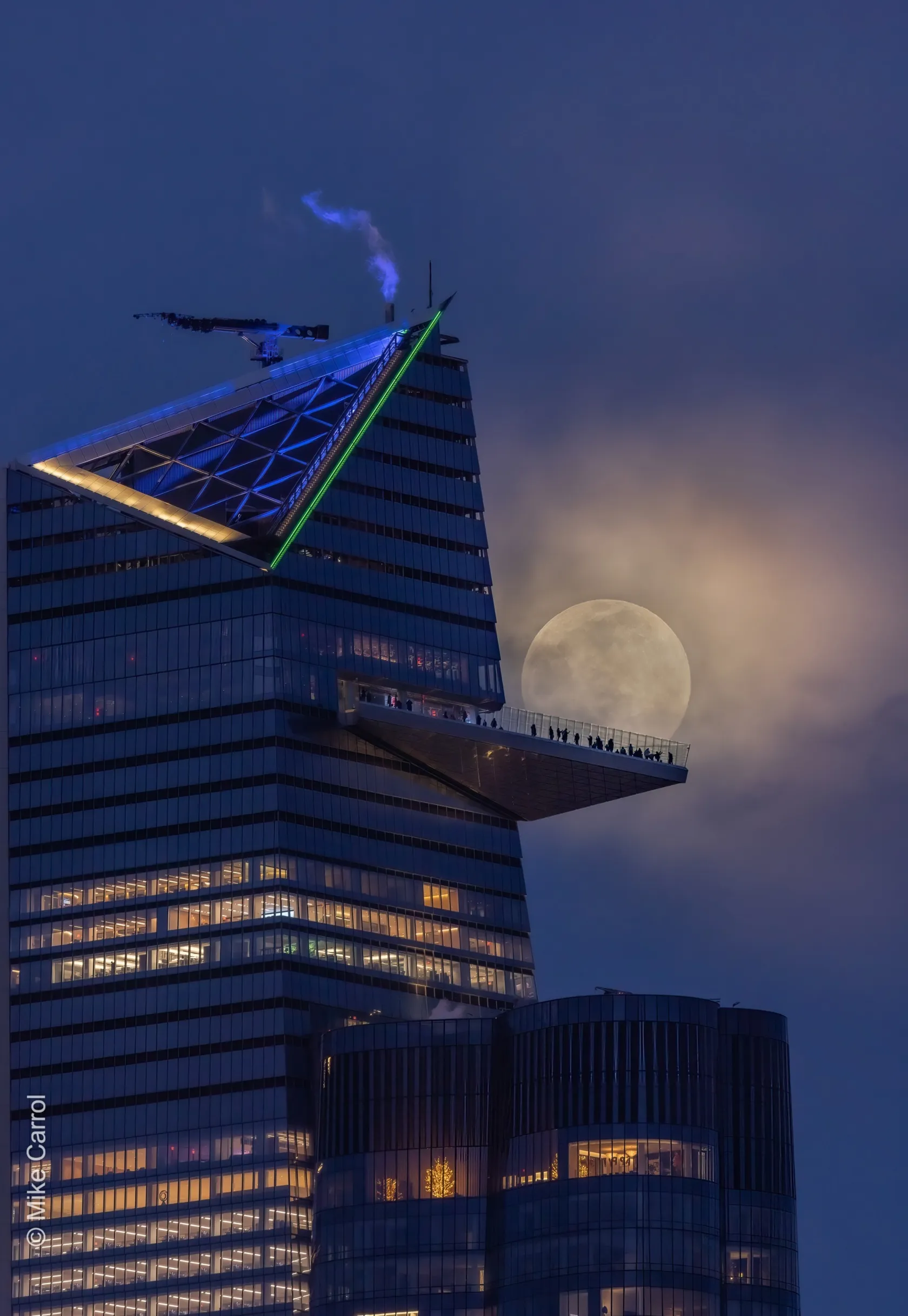
But photographing a Blue Moon isn’t simply a matter of pointing your camera at the sky. The most memorable images usually include something else in the frame — a landmark, landscape, building, or person — to give the Moon a sense of scale and place.
Don’t feel like reading the whole breakdown? We’ve pulled together a quick summary below.
Key Takeaways
- A Blue Moon does not normally appear blue.
- There are two definitions: monthly and seasonal.
- The next seasonal Blue Moon is expected on May 20, 2027.
- The next monthly Blue Moon is expected on December 31, 2028.
- A telephoto lens is useful when you want the Moon to appear large in the frame.
- A tripod helps with stability, but shutter speed should still be fast enough to account for the Moon’s movement.
- Photographing the Moon near the horizon can create more interesting compositions.
- RAW files give you more flexibility when editing exposure and color.
What Is a Blue Moon?
 The Moon goes through its phases on a cycle of roughly 29.5 days. Because calendar months are generally a little longer, a month can occasionally contain two full moons. The second full moon is commonly called a monthly Blue Moon.
There is also a second definition. When an astronomical season contains four full moons instead of the usual three, the third full moon is called a seasonal Blue Moon.
So the phrase doesn’t describe the Moon’s color. It describes the timing of the full moon.
Exclusive Tools of Endless Possibilities in One Editor
Is a Blue Moon Actually Blue?
Usually, no.
The Moon can sometimes appear reddish, orange, yellow, or even bluish because of atmospheric conditions, but that has nothing to do with the Blue Moon definition.
A genuinely blue-looking Moon is an extremely unusual atmospheric phenomenon. It should not be expected simply because a full moon has been designated a Blue Moon.
When Is the Next Blue Moon?
If you’re planning a dedicated Blue Moon photography session, it helps to know which definition you’re following.
The next seasonal Blue Moon is expected on May 20, 2027. The next monthly Blue Moon is expected on December 31, 2028. Exact local dates and times can differ by time zone.
This also makes it important to check an astronomical calendar for your specific location rather than relying only on a date from a general article.
Why Photograph a Blue Moon?
The Blue Moon itself isn’t necessarily dramatically larger or more colorful than an ordinary full moon. What makes it interesting for photographers is the opportunity to build a story around a relatively uncommon celestial event.
Instead of photographing a Moon against a completely black sky, consider including:
- A city skyline
- A famous building
- A lighthouse
- A mountain
- A church or castle
- Trees
- A bridge
- A coastline
- A person or silhouette
The Moon can then become part of a larger composition rather than simply being the subject.
Planning Your Blue Moon Photo
1. Find the Exact Moonrise Time
Moonrise varies depending on your location, date, and landscape.
Before the shoot, check an astronomy or photography-planning app to determine:
- Moonrise time
- Moonset time
- Moon azimuth
- Moon altitude
- Direction of the Moon
- Position of the Sun around sunset
This information can help you determine whether the Moon will appear behind the landmark or landscape you want to photograph.
2. Scout Your Location in Advance
Location can make a bigger difference than expensive equipment.
A photograph of a full moon by itself can be attractive, but adding a recognizable foreground can make the image much more distinctive.
Look for locations where you can align the Moon with:
- A skyline
- A mountain ridge
- A tower
- A bridge
- A road
- A body of water
Remember that the Moon can look surprisingly large when photographed with a long lens, but its apparent size relative to a foreground object depends heavily on your shooting position and focal length.
3. Choose a Telephoto Lens
A telephoto lens is usually the best choice for detailed Moon photography.
Longer focal lengths make the Moon occupy more of the frame and allow you to isolate it from a distant landscape.
A lens in the 200–600mm range can be particularly useful, depending on your camera and the composition you’re planning.
You don’t necessarily need the longest lens available, though. A shorter telephoto lens may be better if you want the Moon and a substantial amount of the surrounding landscape in the same frame.
Camera Settings for Blue Moon Photography

There is no single perfect combination of settings because brightness changes with the Moon’s position, atmospheric conditions, and the surrounding scene.
As a starting point, try:
| Setting | Starting point |
| Mode | Manual |
| ISO | 100–400 |
| Aperture | Around f/5.6–f/8 |
| Shutter speed | Around 1/125–1/500 sec |
| Focus | Manual |
| File type | RAW |
The Moon is much brighter than the surrounding night sky, so a common mistake is to use a long exposure that makes the Moon look like a featureless white circle.
Start with a relatively fast shutter speed and review your histogram and highlights. If the Moon’s surface details are disappearing, shorten the exposure.
Elevate Your Photography with Our Advanced Software
Focus Carefully
Autofocus can struggle in dark conditions, especially when there aren’t many contrasty objects in the frame.
One reliable approach is to focus on the Moon or a distant bright object and then switch to manual focus.
If your camera offers focus magnification or focus peaking, use those tools to fine-tune focus.
Don’t Automatically Use a Very Small Aperture
The original advice to use f/8–f/11 as a general rule is a little too rigid.
You may get better results somewhere around f/5.6–f/8, depending on your lens. The important thing is to balance sharpness, depth of field, and shutter speed.
For a Moon-only image, depth of field is rarely the limiting factor. For a foreground-and-Moon composition, your approach may be different.
Photograph the Moon as It Rises

Moonrise is one of the best opportunities for a compelling Blue Moon photograph.
When the Moon is close to the horizon, you can include more of the landscape around it. The surrounding sky may also still contain some color if moonrise occurs around sunset.
This gives you the possibility of capturing a large bright Moon against a blue, purple, or orange sky rather than a completely black background.
Keep shooting as the Moon rises. Its position relative to buildings, mountains, or other objects will change quickly.
Try a Moon Composite
Sometimes the composition you want isn’t possible in a single exposure.
For example, you might want:
- A properly exposed Moon with visible surface detail
- A brighter foreground
- A large Moon positioned precisely behind a landmark
These elements can have very different exposure requirements.
Instead of forcing everything into one exposure, you can create a carefully planned composite from separate photographs. Just make it clear if the final image is a composite when that distinction matters to your audience.
Use a Tripod — But Know When You Don’t Need One

A sturdy tripod can make your setup easier, particularly when you’re composing a scene with a foreground.
However, a tripod doesn’t automatically mean you should use a very slow shutter speed.
The Moon is moving across the sky, and a long exposure can blur its details. With a long telephoto lens, even small movements can become visible.
For a Moon-only shot, a faster shutter speed and a stable shooting position may be more important than a long exposure.
If you’re using a tripod, disable image stabilization only when your camera or lens manufacturer recommends doing so for tripod use. Modern stabilization systems vary, so don’t treat this as a universal rule.
Take Multiple Exposures
Don’t stop after one successful frame.
During the shoot, vary:
- Shutter speed
- Aperture
- Composition
- Focal length
- Focus
- Exposure compensation, if you’re using an automated exposure mode
Slight changes can produce very different results, especially when the Moon is close to the horizon.
Bracketing can also be useful when you want both a detailed Moon and a brighter foreground.
Editing Blue Moon Photos
Post-processing is especially useful for Moon photography because the original scene can contain extreme differences between bright lunar details and dark surroundings.
Start with the basics:
- Correct exposure.
- Recover highlights if necessary.
- Adjust shadows carefully.
- Fine-tune white balance.
- Add moderate contrast.
- Enhance texture or detail without creating halos.
- Crop for a stronger composition.
For RAW files, Luminar can be used to adjust exposure, color, contrast, and detail.

You can also use GenErase to remove distracting elements from an otherwise clean composition.
The goal isn’t to make the Moon look artificially dramatic. Subtle adjustments usually preserve more natural-looking lunar detail.
Your AI-Powered Photo Editor for MacOS and Windows
Common Blue Moon Photography Mistakes
| Mistake | Why it causes problems | Better approach |
| Using a very slow shutter speed | Moon details can blur | Start with a faster shutter |
| Exposing for the dark sky | The Moon becomes overexposed | Expose for lunar detail |
| Using only a wide-angle lens | The Moon may look tiny | Try a telephoto lens |
| Photographing from the first location you find | The composition may feel generic | Scout the foreground first |
| Relying completely on autofocus | Focus can shift in low light | Check focus manually |
| Editing too aggressively | Lunar detail can look artificial | Use moderate sharpening and contrast |
| Forgetting the foreground | The image may lack context | Include a landmark or landscape |
| Ignoring weather | Clouds can hide the Moon | Check the forecast beforehand |
Blue Moon Photography Checklist
Before leaving for the shoot, check:
- Moonrise and moonset times
- Moon position and direction
- Weather forecast
- Local light pollution
- Camera batteries
- Memory cards
- Telephoto lens
- Tripod
- Remote shutter or timer
- Manual focus settings
- Planned shooting location
Final Thoughts
A Blue Moon isn’t blue, and it isn’t necessarily dramatically different from an ordinary full moon. Its photographic appeal comes from the rarity of the event and the opportunity to build a memorable composition around it.
The best results usually come from planning rather than simply waiting for the Moon to appear. Scout your location, check the Moon’s position, choose an appropriate focal length, expose carefully for lunar detail, and keep shooting as the Moon moves through the scene.
And remember that you don’t have to wait for a Blue Moon to practice. Every full moon is an opportunity to test your settings, experiment with compositions, and learn how your equipment handles a bright subject against a dark sky.
Once you’ve captured your images, Luminar can help you refine exposure, color, contrast, and detail while keeping the final photograph natural.
FAQ
No. A Blue Moon is a name describing the timing of a full moon. It does not normally change the Moon’s color.
A telephoto lens is generally the best choice when you want the Moon to appear large in the frame. A focal length of 200mm or longer can be useful, while longer lenses provide more magnification.
Start around ISO 100–400, f/5.6–f/8, and a shutter speed of roughly 1/125–1/500 sec. Treat these as starting points and adjust them according to the Moon’s brightness and your composition.
The next seasonal Blue Moon is expected on May 20, 2027. The next monthly Blue Moon is expected on December 31, 2028. Exact dates can vary by time zone.
Yes. A smartphone can capture the Moon, especially when combined with a tripod and manual camera controls. However, a dedicated camera with a telephoto lens gives you considerably more control over focal length, exposure, and lunar detail.