
Level up your 2026 FIFA World Cup photography by mastering high-speed action techniques and professional-grade editing for powerful results.
The stands erupt as the ball flies into the net, and at that very moment, you press the shutter button. The 2026 FIFA World Cup will be the largest in history, as the number of participating countries has been expanded to 48 for the first time, with matches spread across three host nations. For an enthusiastic photographer, this is a rare chance to capture the reactions of a wide variety of fans.
Don’t feel like reading the whole breakdown? We’ve pulled together a quick summary below.
Key Takeaways
- Master the exposure triangle. Freeze fast-paced action with a shutter speed of at least 1/1000, use an aperture of f/2.8 to isolate subjects, and adjust ISO to suit stadium lighting.
- Equip for stadium scale. Use two bodies with telephoto and zoom lenses to switch quickly between field distances, while keeping ample spare batteries and storage for thousands of RAW files.
- Prioritize professional gear. Flagship mirrorless cameras ensure reliable focus tracking and high frame rates, with the RAW format being mandatory for preserving quality during post-processing.
- Follow strict regulations. FIFA bans professional equipment for non-accredited attendees, and any unauthorized commercial use of match photography can lead to severe legal penalties.
A Soccer Photographer’s Cheat Sheet

Photographing soccer in a large stadium is, above all, about dealing with long distances and high speeds. Players are constantly moving across the vast field, and the light from the sun and floodlights creates deep shadows and strong contrasts. Without preparing your equipment and manually adjusting the exposure triangle, you won’t be able to capture a detailed, sharp image. What exactly do you need? The whole point of shooting is the ability to compensate for the distance from the subject and capture fast motion.
Skills alone won’t be enough here, so you’ll need to be fully equipped. Two cameras are required. This makes it possible to switch between plans quickly. The ball could be on the other end of the field by the time you manually switch lenses. Bring a long-range telephoto lens to capture action in the center and at a distance. A versatile mid-range zoom lens will be required for shooting when the point of interest is close by.
Be sure to bring extra storage cards and spare batteries. During a single 90-minute match, you can take over 3,000 photos. If the average raw file size is 50 MB, that’s roughly 146 GB of footage. With such intense shooting, the battery will drain before your eyes. Ideally, bring 4 to 6 batteries for each camera. This should last until you arrive at the press center and begin editing.
Whether it’s the players or the ball, the rhythm of movement will constantly change. Therefore, the photographer will need to adjust the camera settings on the fly. The main focus of football photography settings is on the exposure triangle:
- a shutter speed of around 1/1000 is needed to prevent running players or a flying ball from appearing blurry;
- the aperture should be opened wider, at least to f/2.8, to shift the focus to the subject and blur the background;
- sensitivity will need to be adjusted according to the time of day and lighting conditions, but it is usually set to ISO 3200-6400
Set the file format to RAW. Shouldn’t that go without saying? For events that happen only once every four years, you absolutely must not shoot in any other format. After all, the details lost in JPEG or TIFF files cannot be recovered. Yes, unprocessed files take up more space, but in post-processing, the results will be of stunning quality.
Which Camera Should I Get?

To photograph soccer matches in stadiums across the U.S., Canada, and Mexico, it’s best to use full-frame mirrorless cameras from the flagship or sub-flagship segments. Among professional tools, the Alpha 9 III leads the pack. Thanks to this Sony camera, shots of a flying ball or a running soccer player come out clear. There is no distortion or blurring.
The “second group” includes the Nikon Z8 and Canon EOS R3. These models are chosen for the balance they offer between reliability and battery life. That said, Canon EOS R3 features large, heavy bodies with a built-in vertical grip and a massive battery. The Nikon Z8 offers the same speed and electronics, but in a lightweight, compact body that’s easier to hold for 90 minutes straight.
The budget-friendly options are the Canon EOS R6 Mark II, the Nikon Z6 III, and the Sony Alpha 7 IV. These are versatile reportage cameras that are often chosen as a backup body or when working with a limited budget.
| Camera Model | Price | Shooting Speed | Sensor (Resolution) | Autofocus | Size and Weight |
| Sony Alpha 9 III | ~$6400 | Up to 120 fps | 24.6 MP | Locks onto the player with the ball automatically | Compact body (703 g) |
| Canon EOS R3 | ~$4000 | Up to 30 fps | 24.1 MP | Instantly tracks jerseys, faces, and fast ball passes | Large body with an integrated lower grip (1015 g) |
| Nikon Z8 | ~$3600 | Up to 20 fps | 45.7 MP | Switches targets instantly by looking at a player | Medium body (910 g) |
| Nikon Z6 III | ~$2500 | Up to 20 fps | 24.5 MP | Isolates players reliably in crowded penalty boxes | Compact body (750 g) |
| Canon EOS R6 Mark II | ~$2300 | Up to 40 fps | 24.2 MP | Tracks running players stably during midfield duels | Compact body (670 g) |
| Sony Alpha 7 IV | ~$2000 | Up to 10 fps | 33.0 MP | Follows fast attacks and wingers on the move | Compact body (658 g) |
They all support RAW shooting, so you won’t have to worry about how to edit sports photos. And some can shoot in multiple formats at once. But do you really need that, considering how quickly your memory cards will fill up?
The Best Lens for Football Photography

The one thing the soccer community agrees on is that football photos must be sharp. And for that, you’ll need a good lens. A really good lens.
- 400mm f/2.8. Its maximum aperture and focal length perfectly isolate a running player from the stands, while maintaining sharp facial details and the dynamic action in the penalty area from the opposite end of the field.
- 70-200mm f/2.8. Indispensable on a second camera body for capturing action along the sideline, coaches’ reactions on the bench, and the fans’ wild celebrations immediately after a goal is scored.
- 24-70mm f/2.8. The optimal choice for indoor work, including official press conferences, shooting in the tunnel under the stands before the teams come out, and reports from the championship locker room.
To “reach” any spot on the fields of massive American stadiums, you can use the 600mm f/4. With this equipment, the field is right at your fingertips, but changing positions with such a heavy piece of gear isn’t very convenient.
Infuse Your Photos with Dynamic Energy Using the Motion Blur
Exposure Triangle Settings

When photographing soccer at the 2026 World Cup, exposure and color settings are adjusted manually (M), as the camera’s standard modes don’t provide the necessary precision. The foundation is a shutter speed of 1/1000 to 1/2000 of a second, which captures the rapid movement of players and the ball without blurring. To compensate for low light, the aperture is opened as wide as possible.
Light sensitivity can be set manually or left to the Auto ISO function, with a limit of 6400: while the main settings remain static, the light sensitivity automatically adjusts to the high-contrast shadows in the stadium. Set the white balance to 5200K for sunlight or 4200K under floodlights so that the color of the skin and the grass doesn’t change from frame to frame. This will be enough to ensure the resulting photo looks rich and sharp.
Football Photography Ideas

There isn’t always something exciting happening on the field. Take, for example, the match between England and the U.S. at the 2022 FIFA World Cup. The group stage match ended in a (0-0) draw and was marked only by endless yawning from the stands. Defensive soccer with not a hint of dangerous moments. What should a photographer do in such moments? Get creative and go with a concept.
- Focus on the tactile microdynamics. Aim your lens at the details of the body during moments of stillness or intense collisions. Capture the leg muscles strained to the limit as they push off, the clumps of torn turf flying from under the cleats, and the beads of sweat flying from the hair during a header.
- Shooting through heat waves and haze. Sit at the farthest point behind the goal and shoot the opposite side of the field through the haze of hot air rising from the turf. Temperature fluctuations will create a “liquid,” flowing frame effect. The players near the far goal will turn into impressionistic, wavering figures.
- Distortion via Global Shutter. Instead of the usual capture of the moment of impact, shoot the contact points at a shutter speed of 1/8000 sec as close to the subject as possible. The goal is to capture a microsecond of physical deformation: the moment when a soccer ball is literally flattened against the boot by a powerful strike.
If you combine a good concept with excellent post-processing, the photo could even become a classic. The secret is to keep trying, experimenting, and not limiting yourself to just one format. Even football field photography can be captured without players, let alone moments from an actual match.
Professional Editing. Now in Your Pocket.
Download Luminar on your Mobile Device
How to Improve FIFA Photography in Luminar Neo
The photo is ready, but do you feel like something’s off? Use a photo editor to fix it. With Skylum’s product, you can fix even major issues in just a few seconds.
- Harsh stadium shadows cast by the roof overhang. The “Enhance AI” tool helps balance the lighting. Details become visible even in the darkest areas.
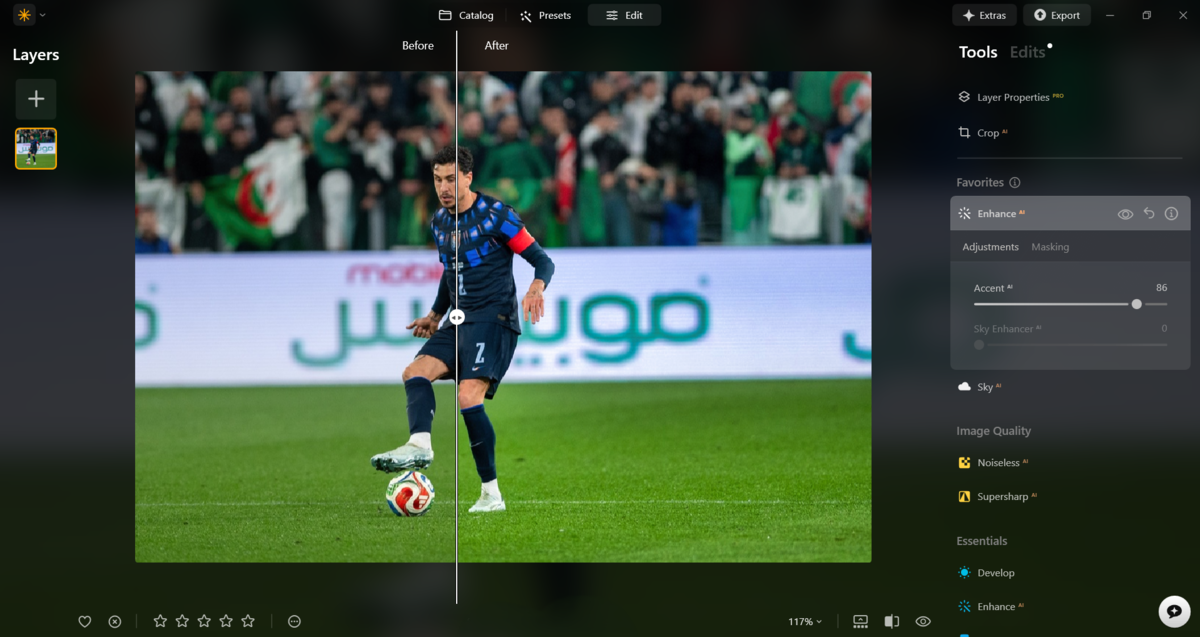
- A cluttered background of bleachers and advertisements distracts from the subject. The “Portrait Bokeh AI” feature subtly blurs the background, isolating the players.

- Flat texture of the uniforms and lackluster details. The “Structure AI” slider precisely improves microcontrast, highlighting the texture of the uniforms, beads of sweat, and the structure of the grass.

- Random debris and extraneous elements on the field. The AI-powered “Erase” tool identifies the subject and cuts it out without affecting the surroundings.
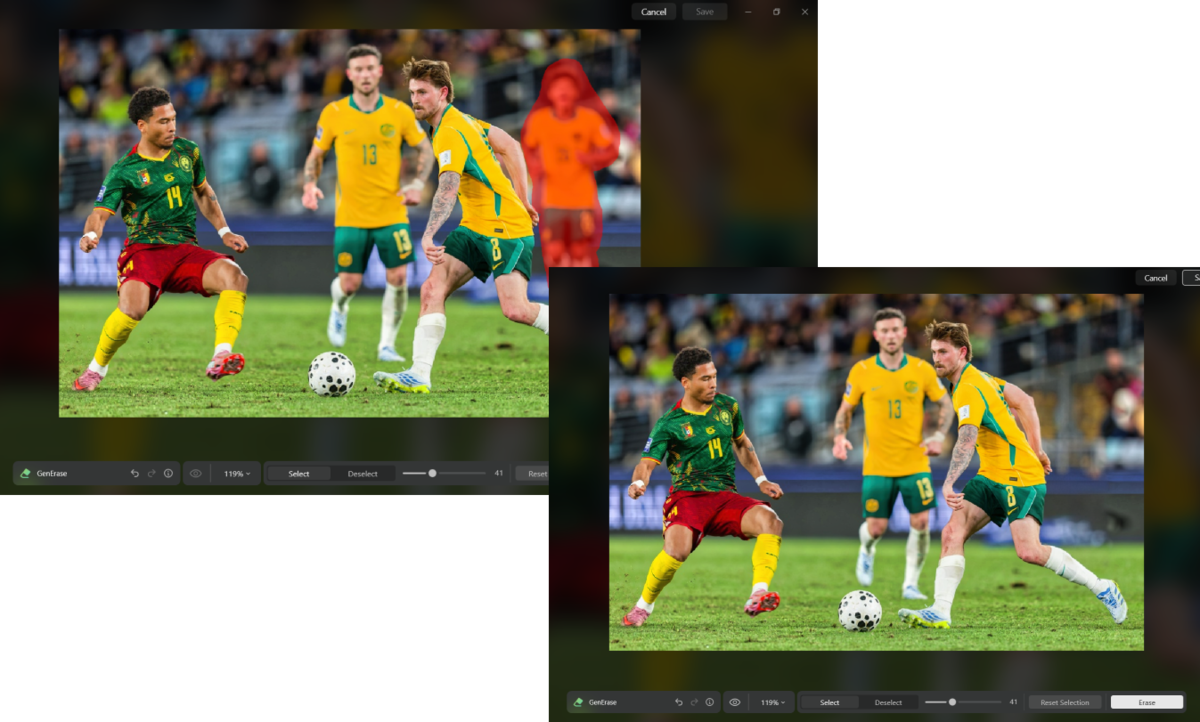


The Luminar Neo features cover every aspect of the editing process, enabling you to make small adjustments, replace the sky, or fill in empty spaces. Experiment to discover a whole new perspective on your familiar soccer photos.
Don’t Stop—Keep Taking Pictures
Capturing the perfect shot of fast-paced action requires quick reflexes, but a figure ot of exposure, the capabilities of your lens, and strict accreditation rules. Set up your equipment in advance and experiment with different angles. Capture the raw emotions of the stands and the intense excitement on the field during the official 2026 FIFA World Cup dates from June 11 to July 19.


