Discover how the Fujifilm X Half stands out with its unique features and performance, offering photographers a fresh perspective beyond typical mirrorless cameras.
The X-HF1 is compact and stylish, but after paying $850, many photographers end up disappointed. With its Fujifilm X battery, it weighs just 240 grams, making it hard to tell apart from a toy. It has a one-inch sensor, a fixed lens, and you can’t even enable RAW file saving. And yet, people love this camera, buy it, and leave positive reviews. What’s the secret?
Don’t feel like reading the whole breakdown? We’ve pulled together a quick summary below.
Key Takeaways
- Concept-focused. The Fujifilm X-HF1 is a niche device designed to mimic the analog experience and not a high-performance tool like the professional X-H line.
- Unique tactile design. It features a vertical-format sensor, a mechanical film advance lever, and retro styling, prioritizing the creative process over modern ergonomics.
- Visual characteristics. With its 1-inch sensor, fixed f/2.8 lens, and JPEG-only output, it produces a soft vintage aesthetic rather than technical high-resolution sharpness.
- Portability and efficiency. Weighing just 240 grams, it is highly compact and offers excellent battery life, capable of capturing up to 880 shots on a single charge.
- Intentional shooting. By limiting digital features like omitting RAW support and lens swaps, the camera encourages a slower and more deliberate workflow, perfect for street photography enthusiasts.
Overview of the Fujifilm X-H Series
Fujifilm has organized its cameras into different series to make choosing a camera less of a hassle. For example, the X-T and X-Pro series are designed for enthusiasts who appreciate retro aesthetics and classic controls. The simple X-S and X-E series are ideal for beginners and hobbyists, while the X-H cameras were designed with complex, professional photography in mind and therefore offer performance.
The X-HF1 camera is often mistakenly classified as part of the X-H series, which leads people to expect a professional workhorse when they buy it.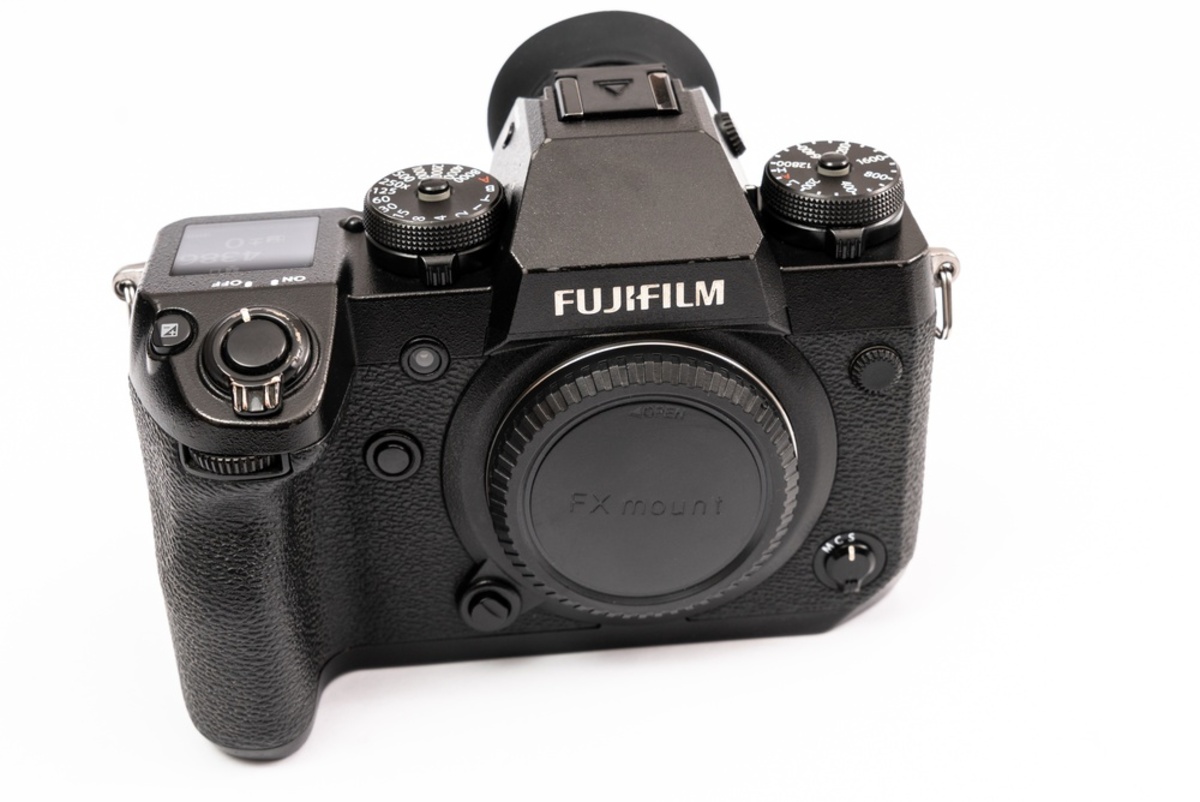 The letters “HF” in the model number stand for “Half-Frame” and do not indicate that it belongs to the X-H line. It occupies a distinct place within the brand’s ecosystem and represents a unique, compact hybrid between the X digital series and Instax instant cameras.
The Fujifilm X-Half is just an expensive toy.
Exclusive Tools of Endless Possibilities in One Editor
Design and Build Quality
The design of the Fujifilm X-Half camera is inspired by the FUJICA Half film camera, released way back in 1963. The body is made of matte metal and textured eco-leather. There are almost no control buttons on the body, so framing settings are accessed through the digital menu. The top plate features only aluminum dials, which rotate to adjust exposure compensation settings.
The rear panel offers more interesting features. There’s a small display for selecting film simulations for your shot, as well as a cocking lever. Pulling this lever switches the camera to diptych mode.
Image Performance

The Fujifilm digital film camera is designed to produce high-quality images with a “film-like vibe.” If you’re expecting highly detailed, sharp photos, this camera simply isn’t for you. That doesn’t mean it takes bad pictures. It’s just that achieving that kind of result with its specs and built-in features would be physically impossible.
- Lack of RAW format support. The camera shoots exclusively in JPEG. The images you get will always be “compressed” and pre-processed by the camera itself. This makes it harder to bring out fine details during post-processing, and the results will look less natural.
- Lens sharpness drops toward the edges. Since the lens was designed to be as flat as possible to keep the body compact, its optical design does not distribute light evenly to the corners of the sensor. The center of the frame remains sharp, but the edges are insufficiently resolved, resulting in a loss of detail.
- An f/2.8 aperture on a 1-inch sensor. The lens lets too little light through to the sensor. Because of this, in low light, the camera significantly overcompensates by increasing the ISO sensitivity. As a result, digital noise appears in the photos, which completely erases sharpness and turns fine details into a blur.
Thanks to its vertical orientation and the ability to simulate a film-like look even before AI photo retouching, the camera’s technical limitations can be transformed into a unique artistic style. The X-HF1 is easy to use, and the photos it produces have a soft, vintage look. It weighs just a little more than a typical smartphone, making it convenient to carry along on walks.
Your AI-Powered Photo Editor for MacOS and Windows
Autofocus and Speed
The Fujifilm X-Half’s autofocus uses contrast-detection AF, like early cameras such as the original X100. Instead of measuring distance, it moves the lens to find maximum sharpness, so it needs decent light to work well. Its small 1-inch sensor also limits natural background blur—for stronger bokeh, try Luminar’s blur background tool afterward.
Fujifilm deliberately kept the X-Half’s pace unhurried, echoing analog cameras. It does support continuous shooting, but only around 1 frame per second, making it better suited to single, considered shots than action. With Film Camera mode engaged, you must manually push the retro advance lever before each new shot, just like winding old film.
Lens Compatibility and Options

The Fujifilm X-Half camera is equipped with a fixed 10.8 mm f/2.8 wide-angle lens. In other words, it is simply not possible to attach a third-party lens or a Fujifilm XF-series lens. Furthermore, the camera lacks optical zoom or a flash, so the only way to get a sharper shot is to improve shooting conditions.
Battery Life and Portability

From its release date, no camera was released that was lighter or more compact than the X-HF1. It’s small, almost unnoticeable. This makes it convenient to take along on walks and trips. However, to achieve such compactness, certain specifications had to be sacrificed, including the capacity of the built-in battery.
The Fujifilm X-HF1 uses the classic Fujifilm NP-W126S battery, with a capacity of 1,260 mAh. By comparison, the battery capacity in most standard smartphones today is 3-4 times greater. However, thanks to the absence of an electronic viewfinder, the 1-inch sensor, and the tiny 2.4-inch screen, the device delivers surprisingly good results—up to 880 shots on a single charge.
User Interface and Controls

Exposure settings on the Fujifilm X-Half combine analog and digital controls. The aperture is adjusted using a mechanical ring on the lens, while exposure compensation is adjusted using a dial on the top panel. Individual exposure settings, including ISO sensitivity and shutter speed, are adjusted via the digital menu.
The settings can be adjusted with simple swipes, but due to the small screen size and low sensor sensitivity, this may not be the easiest task. Swiping up opens a quick menu with main features, while swiping left and right controls film simulations and creative filters. The film simulation is displayed on a separate circular screen.
Elevate Your Photography with Our Advanced Software
Pros and Cons of the Fujifilm X-H Cameras

The Fujifilm X-HF1 camera prioritizes aesthetics, the creative process, and the atmosphere of the moment over perfect technical image quality. It’s not a tool that will suit every photographer. Only a connoisseur of vintage cameras, film photography, and constant travel will be able to fully unlock its potential.
| Pros | Cons |
| Unique analog experience via the mechanical frame advance lever and retro design for replicating the classic film aesthetic | Overpriced at around 850$ feels high for the available technical specifications |
| Native vertical format means the sensor is oriented for 3 by 4 shooting for Shorts, Reels, and stories | A small sensor measuring 1 inch with 17.7 MP delivers lower quality than standard APS-C sensors |
| Screen ergonomics include two displays on the back panel for film simulations and for menu settings | Limited video capabilities mean recording only in Full HD 1080p format, with no 4K resolution support |
| Creative modes offer signature Fujifilm simulations and automatic combining of two frames into one diptych | Parallax effect in the optical viewfinder shifts the frame when shooting close objects |
| Excellent battery life with the NP-W126S pack provides a compact record of 880 shots on a single charge | Fixed lens features a 32 mm equivalent focal length and an f/2.8 aperture with no optical zoom |
| Ultra-compact build with a weight of just 240 grams lets you carry the camera in a pocket every day | Weak blur from the combination of a small sensor and an f/2.8 aperture makes it hard to get strong artistic bokeh |
That said, the Fujifilm X-Half has no direct digital counterparts. It is the only digital camera designed as a conceptual tribute to the half-frame film aesthetic, featuring a mechanical film advance lever and a native vertical sensor.