Ready to buy a drone in 2026? Check out our helpful guide covering everything from camera drones to FPV racing. Get the best tips to make an informed decision today!
Buying a drone is easier when you begin with what you want to do rather than with a list of specifications. A compact travel drone, an FPV model, and a professional camera drone may all fly, but they are designed for very different experiences.
This drone buying guide explains the main categories, the features that matter, and the costs and regulations to consider before making a purchase.
Don’t feel like reading the whole breakdown? We’ve pulled together a quick summary below.
Key Takeaways
- Choose the drone category according to your intended use: learning, photography, self-filming, FPV, racing, or professional work.
- Takeoff weight can affect registration, training, and where the drone may be flown.
- A larger sensor, RAW support, and a mechanical gimbal matter more for photography than resolution alone.
- Manufacturer flight-time figures are measured under controlled conditions; real flights are shorter.
- Obstacle sensing helps, but it does not make a drone crash-proof.
- Check local aviation rules and restricted airspace before buying or flying.
- Include spare batteries, storage, filters, insurance, and repairs in the total budget.
- Confirm that replacement propellers, batteries, and service are available in your region.
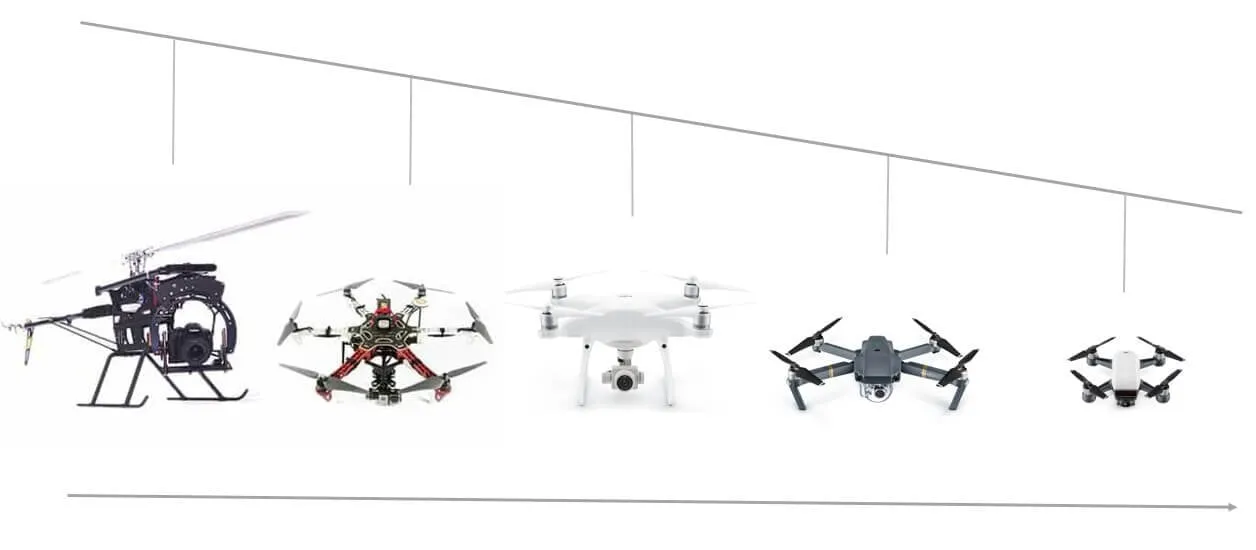
Types of Consumer Drones
| Drone type | Best for | Main advantages | Main trade-offs |
| Beginner or toy drone | Learning basic control | Low cost, simple operation, durable guards | Short flight time and limited camera quality |
| Selfie or follow-me drone | Recording yourself and social content | Compact, automated tracking, quick launch | Limited wind resistance and fewer manual controls |
| Mini camera drone | Travel and everyday aerial photography | Portable, capable camera, easier to carry | Smaller sensor and lighter wind resistance |
| Advanced camera drone | Serious photo and video work | Larger sensors, stronger wind performance, more camera options | Higher cost and more regulatory requirements |
| FPV or cinewhoop | Immersive flying and dynamic video | First-person view, agility, close-proximity footage | Steeper learning curve and shorter endurance |
| Racing drone | Competitive flying | Speed, low latency, repairable design | Usually unsuitable for polished aerial photography |
| Enterprise drone | Inspection, mapping, public safety, agriculture | Specialized sensors and workflows | High cost, training, and operational requirements |
Your AI-Powered Photo Editor for MacOS and Windows
Beginner and Toy Drones

Small beginner drones are useful for learning orientation, throttle control, takeoff, and landing. Propeller guards and altitude hold can make the first flights less intimidating.
Do not assume that every small drone is safe to fly indoors. Unprotected propellers can injure people or damage objects, while GPS-based positioning may be unavailable inside. Choose a clear space, follow the manual, and keep children under direct adult supervision.
Toy drones are inexpensive, but their cameras, wind resistance, transmission range, and battery life are usually limited. If aerial photography is the main goal, it may be more economical to begin with an entry-level stabilized camera drone.
Mini Camera Drones

Mini camera drones are popular for travel because they combine a folding body with a stabilized camera and automated flight features. Models around the 250 g threshold can be convenient, but low weight does not remove every legal obligation.
For photography, look for:
- RAW capture;
- a three-axis mechanical gimbal;
- manual exposure controls;
- exposure bracketing and panorama modes;
- sufficient dynamic range;
- reliable return-to-home;
- obstacle sensing suited to your flying environment.
Current lightweight models may offer 4K video, subject tracking, vertical shooting, and longer rated flight times than older hobby drones. Check the exact takeoff weight of the battery and accessory configuration you intend to use.
Selfie and Follow-Me Drones

Selfie drones prioritize quick launch, automated framing, and subject tracking. Some can take off from the palm and follow a person without a traditional controller, making them convenient for hiking, cycling, and short travel clips.
They work best in open environments with predictable movement. Tracking can fail when the subject is obscured, the background lacks contrast, light is poor, or the route contains thin branches and wires.
Before using automated tracking:
- inspect the route yourself;
- set a safe maximum distance and height;
- avoid roads, crowds, water, and restricted areas;
- understand how to cancel the flight;
- keep the drone within visual line of sight where required.
Advanced Camera Drones

Advanced camera drones use larger sensors, stronger airframes, longer-lasting batteries, and more comprehensive obstacle-sensing systems. Some provide multiple focal lengths, allowing photographers to switch between wide and telephoto perspectives without flying closer to a subject.
These models are suitable for commercial video, real estate, landscape work, and carefully planned productions. Their greater weight and capability may also place them in a different regulatory category.
Current reference points include the DJI Air 3S, a 724 g dual-camera drone with a manufacturer-rated maximum flight time of 45 minutes, and the larger DJI Mavic 4 Pro, a triple-camera model rated for up to 51 minutes. Those figures come from controlled tests and should not be treated as usable flight time in every condition.
FPV and Cinewhoop Drones

FPV drones send a live camera view to goggles, creating a more immersive flying experience. Cinewhoops use protected propellers and are designed for smoother close-proximity footage, while freestyle FPV drones prioritize agility and manual control.
Ready-to-fly systems such as the DJI Avata 2 can make FPV more approachable, but goggles and assisted controls do not eliminate risk. Manual FPV flight requires practice, and local rules may require an observer to maintain visual contact with the aircraft.
FPV buyers should compare:
- controller and goggles compatibility;
- video transmission latency and image quality;
- propeller protection;
- battery availability;
- repairability;
- simulator support;
- whether manual mode requires a separate controller.
Racing Drones

Racing drones are built for speed, low-latency control, and rapid repair. Pilots often assemble them from separate frames, motors, flight controllers, video transmitters, receivers, and cameras.
Unlike camera drones, racing models usually do not prioritize long flight times, GPS automation, or stabilized high-resolution footage. Durability and access to replacement parts matter more than polished consumer features.
Beginners should practice in a simulator before flying a powerful racing quad. Joining a recognized club or using an established racing site can also provide a safer introduction to equipment, frequencies, and local rules.
Professional and Enterprise Drones

Professional does not simply mean expensive. A professional drone should match a defined job, such as cinematography, surveying, inspection, thermal imaging, agriculture, search and rescue, or infrastructure monitoring.
These operations may require:
- specialized cameras or payloads;
- mapping or inspection software;
- documented maintenance;
- pilot certification or authorization;
- insurance;
- client contracts and data-management procedures;
- additional crew members.
Before investing, confirm that the complete workflow—not only the aircraft—supports the required accuracy, file formats, software, and legal permissions.
Elevate Your Photography with Our Advanced Software
What to Look for When Buying a Drone

1. Takeoff Weight and Local Rules
Drone laws vary by country and can change. In the United States, recreational drones weighing 250 g or more generally require FAA registration, and recreational pilots must complete the TRUST safety test. Registered drones are also generally subject to Remote ID requirements.
In much of Europe, common low-risk operations fall under the Open category, which is divided into A1, A2, and A3 subcategories. Requirements depend on factors including class marking, weight, training, and distance from uninvolved people.
A drone under 250 g is not permission to fly anywhere. Registration may still apply in some regions, particularly when the aircraft carries a camera, and airports, military sites, national parks, events, and sensitive infrastructure may have additional restrictions.
Always check the current rules from the aviation authority for the country and location where you will fly.
2. Camera and Gimbal
For still photography, compare sensor size, RAW support, lens field of view, aperture, dynamic range, bracketing, and panorama options. Megapixels alone do not determine image quality.
For video, consider frame rates, bit depth, log profiles, bitrate, vertical recording, and whether the camera can maintain quality in low light. A three-axis mechanical gimbal generally produces smoother footage than electronic stabilization alone.
3. Flight Time and Batteries
Rated flight time is measured in favorable test conditions. Wind, cold, hovering, high altitude, aggressive movement, recording, and returning with a safe reserve all reduce practical endurance.
Plan around usable flight time rather than the maximum figure. Two or three batteries are often more valuable than a small improvement in the advertised maximum.
4. Safety Features
Useful features include:
- return-to-home;
- GNSS positioning;
- obstacle sensing;
- low-battery warnings;
- geofencing information;
- propeller guards;
- automatic landing safeguards.
Obstacle sensors may not reliably detect wires, thin branches, reflective surfaces, or obstacles outside their coverage. The pilot remains responsible for the flight.
5. Transmission and Controller
Manufacturer transmission ranges are measured under specified conditions and may exceed legal visual-line-of-sight limits. Buildings, interference, terrain, and local radio-power restrictions can reduce real performance.
Choose between a controller that uses a smartphone and one with a built-in screen. A dedicated display speeds up setup, while a phone-based controller may reduce cost.
6. Repairability and Support
Check the availability and price of:
- batteries;
- propellers;
- chargers;
- gimbal protectors;
- controllers;
- replacement arms or frames;
- manufacturer service and accidental-damage plans.
A discontinued bargain can become expensive if batteries and parts are difficult to find.
Essential Drone Accessories

A practical starter kit may include:
- at least one spare battery;
- compatible high-speed microSD cards;
- spare propellers and the correct tool;
- a protective case;
- an ND filter set for controlled video shutter speeds;
- a landing pad for sand, dust, or wet ground;
- legally required identification labels;
- a fire-resistant method of transporting batteries where appropriate.
Airline rules for lithium batteries vary, so check the carrier’s current requirements before traveling.
Exclusive Tools of Endless Possibilities in One Editor
Editing Drone Photos with Luminar

Aerial photographs often contain haze, high-contrast skies, wide tonal ranges, and small distractions. Luminar can process RAW files, adjust color and contrast selectively, reduce noise, and refine detail using masks.
Keep edits believable when the image is presented as a record of a real place. If you substantially replace the sky or alter the landscape, disclose the manipulation when required by a competition, client, or documentary context.
For more shooting ideas, see our guide to drone photography.
Final Checklist Before Buying
Before placing an order, confirm:
- The drone suits your main use.
- Its weight and class fit the places where you expect to fly.
- The camera provides the required file formats and quality.
- Practical flight time is sufficient with a safe battery reserve.
- Batteries, propellers, and repairs are available locally.
- Your phone, controller, goggles, and software are compatible.
- The complete kit fits your budget and travel plans.
- You understand the registration, training, and airspace rules.
Frequently Asked Questions
A beginner should prioritize stable flight, simple controls, return-to-home, accessible replacement parts, and a price that makes practice comfortable. A small camera drone may provide better long-term value than a toy model if photography is the main goal.
No. Weight affects many rules, but registration, camera use, restricted airspace, distance from people, and operational requirements vary by country. Always check the local aviation authority.
Around 25–35 minutes of rated endurance is practical for many camera-drone users, but actual usable time will be shorter. Spare batteries matter more than chasing the highest laboratory figure.
Look for a mechanically stabilized camera, RAW capture, manual exposure, a suitable field of view, good dynamic range, and reliable bracketing. Sensor size usually matters more than megapixel count alone.
They are useful, especially for beginners and automated flight, but they cannot detect every hazard. They should support attentive piloting rather than replace it.