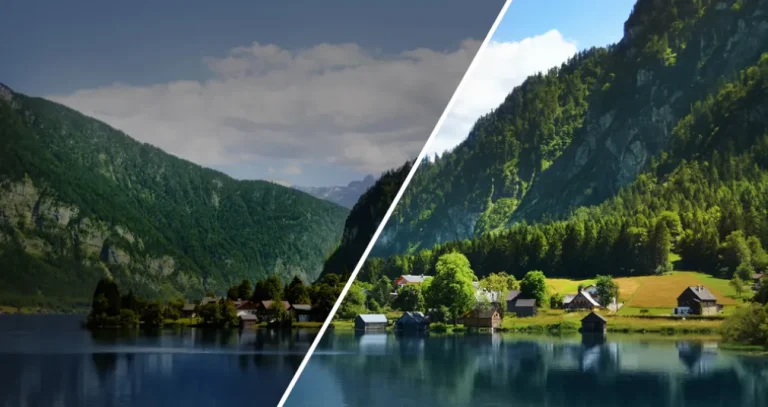
Learn the technicalities of the Sony A7V and how its higher sensor aptitude combines with the current post-processing procedures to generate professional outputs.
The release of the Sony A7V marks a fundamental moment in the evolution of full-frame hybrid cameras, as it merges high-speed data readout with unprecedented processing power. For landscape and portrait photographers, this body represents a sophisticated data-gathering tool designed for the most demanding environments. With its partially stacked sensor architecture, the A7V Sony bridges the gap between enthusiast accessibility and professional-grade performance, setting a new standard.
Don’t feel like reading the whole breakdown right now? Here’s a tighter, more practical summary of what actually changed.
Key Takeaways
- AI integration. With integrated AI editing tools and hardware, subject recognition and the overall workflow can be accelerated to combine the required capture and final export.
- System versatility. Dual-gain ISO sensors deliver cleaner images in high-contrast lighting common in outdoor photography.
- Sensor resolution. Large megapixels are required to permit large-scale printing and aggressive cropping without compromising textural information.
- Dynamic range. With 14+ stops of range, cameras have a cleaner shadow recovery, particularly when combined with AI-powered exposure tools.
- Weather sealing. Internal seals safeguard sensitive electronics against moisture and dust, ensuring reliability in remote locations.
- Software integration. The maximum of the RAW files can be obtained using sophisticated processing engines under harsh conditions.
Features and Specifications of the Sony A7V

The architecture uses a circuitry designed behind the photodiodes, which, like traditional BSI sensors, have a tremendous data throughput. It enables the Sony A7V to shoot at a 30 fps burst rate, virtually doing away with the distortion usually found in shots of fast-moving subjects.
The BIONZ XR2 engine is listed in the technical specifications. The camera can perform 60 AF/AE calculations per second, ensuring each frame is exposed and sharp to perfection at high speed. The files have 16+ stops of dynamic range for photographers who use a raw photo editor, offering the opportunity to explore a blank canvas and restore the darkest shadows and brightest highlights.
Powerful and Feature-Rich RAW Converter
Advanced RAW Workflow and Thermal Management

The A7V has specs such as a robust magnesium alloy internal frame that functions as a primary heat sink, significantly enhancing thermal dissipation during extended shoots. This prevents “hot pixels”, which affect long exposures on lower-end sensors, meaning that on hot summer nights, the 33MP RAW files are free of noise and artifacts.
The Sony A7V produces files with metadata that record lens diffraction and chromatic aberration. An ultra-fast raw image editor can make accurate automatic corrections. It will guarantee that the edge-to-edge sharpness promised by the Sony A7V specs is achieved in the final export, rather than being killed by optical physics.
Image Quality and Performance Analysis
The auto-white balance, powered by AI, is much more consistent in complex lighting conditions, such as forest canopies or during transitions to the golden hour. Such accuracy guarantees that the A7V Sony develops skin tones and natural greens.
When aesthetic depth is valued more, the image pipeline features include presets named creative look, which can be tweaked in-camera. But it is the potential that has been opened in post-processing. Using the Portrait Bokeh AI effect, users can harness the camera’s depth-mapping accuracy to produce professional separation in any background portrait, with the subject popping against the backdrop to optical-grade quality.
Bring Emotional Depth to Your Portraits with Bokeh Effect
Precision Depth Control and AI Bokeh
The high-resolution sensor and superior AF enable it to capture environmental portraits just as well. Among the highlights of the new AI processing unit is its ability to map a scene’s depth in real time and in 3D. It is encoded into the RAW file, where it can be used to create. To help photographers focus on a subject and contrast it against a busy background, the hardware-acquired data provides an artificial mask.
You can achieve a lens-like appearance with tools like Luminar Portrait Bokeh AI.

The software uses image details to differentiate the foreground, the subject, and the background planes. It creates a naturalistic blur that honors the laws of optics, something once impossible without hours of manual masking.
Autofocus System and Speed Evaluation
The system uses human pose estimation technology with 759 phase-detection points that cover 94% of the sensor. The AI-driven autofocus leverages human pose estimation to maintain a lock on a subject’s eyes and head even when they turn away, while the 759 phase-detection points provide near-instant acquisition of smaller subjects like hikers or distant birds.
The speed test also indicates a pre-capture capability of up to 1 second with the A7V Sony. It turns out to be a game-changer in both wildlife and sports, as you will never miss out on the climax of the moment. With the addition of Luminar AI, capturing a high-speed photo and creating a final product is quicker than ever, with the software automating the camera’s smart tracking to handle the rest.
Your AI-Powered Photo Editor for MacOS and Windows
Customization and Professional Ergonomics

The A7V Sony’s features include a redesigned focus map that assists in visualizing depth of field and a rear dial that can be programmed to control ISO or exposure compensation. Such a physical interface is meant to be out of the way, enabling the photographer to remain in the moment, with data processing bearing a load in the specifications.
The Sony A7V release date marked the day the industry no longer needed custom-made bodies. By including Luminar AI in your post-processing workflow, you can invest all your energy in the artistic process your Sony A7V helps you conduct, and put aside the manual cleaning/polishing of your work, such as sensor dust removal or simple color grading.
Battery Life and Charging Efficiency

With the more efficient BIONZ XR2 processor, the camera has a battery life of around 630 shots with the EVF and 750 with the LCD. The specifications show 90 minutes of continuous 4K recording at 25 C.
Charging is handled by two USB-C ports, with USB-PD (Power Delivery) support, enabling fast charging for camera batteries. It helps the Sony A7V be supplied via an external battery pack during long-exposure and star-trail sessions, or when tethered to a studio setup. The power flexibility makes it one of the most reliable features for professional expeditions where there are no power outlets.
Design, Build Quality, and Ergonomics
The Sony A7V has the same Alpha silhouette but features a newer, more sturdy magnesium alloy frame. The grip is slightly modified to fit bigger hands and has been better balanced with heavy telephoto lenses.

The battery compartment and card slots have received better weather sealing. These structural upgrades ensure the camera’s moisture and dust resistance meets the rigorous standards for professional outdoor expeditions, protecting its internal electronics from salt spray, humidity, and fine grit.

The most fundamental upgrade is the 4-axis multi-angle monitor, which combines the flexibility of a flip-out screen with the stability of a tilt screen. It makes easy composition both vertically and horizontally.

The hardware’s build quality justifies its price through outstanding construction and provides resilience in a rough outdoor environment.
Exclusive Tools of Endless Possibilities in One Editor
Connectivity and Storage Features
The Sony A7V serves as a high-speed connectivity hub, leveraging Wi-Fi 6E to enable rapid data transfers across the 6GHz band. It comes in handy, especially when sending previews just as the client would want or posting them through social media. The dual storage slots can accept both UHS-II SD cards and CFexpress Type A cards, enabling speeds sufficient to empty the 30 fps buffer.
CFexpress type A integration features are high-priority to support high-bitrate video, and both 4K 120p recording and playback are supported without dropped frames. It makes the Sony A7V a true hybrid, as it can switch between professional photography and top-quality cinematography with the press of a button.
Comparison with Previous Sony A7 Models

Each subsequent version of the series can change a photographer’s working arrangements. The replacement of traditional sensors with a stacked architecture and the addition of specialized processing chips are defining the prevailing industry standard.
| Feature | Sony A7 III | Sony A7 IV | Sony A7V |
| Sensor type | BSI CMOS | BSI CMOS | Partially stacked |
| Burst rate | 10 fps | 10 fps | 30 fps |
| Video quality | 4K 30p | 4K 60p | 4K 60p |
| AI unit | None | None | Dedicated AI chip |
The Sony A7V is more than simply an upgrade in resolution. The speed of readout, the presence of an AI module that automates the most sophisticated focusing and exposure functions, and the automation of these functions are the primary distinguishing features.
Market Impact and Future-Proofing
The release date of the Sony A7V at the end of 2025 changed the game in the mirrorless market. Sony has questioned conventional camera body design by offering 30 fps and stacked sensors. For users seeking superior cameras, the A7V represents a less costly but more balanced option compared to the expensive “R” line, particularly given access to the current AI-powered sharpening and upscaling software.
The compatibility of the Sony A7V ecosystem ensures the camera will not go out of fashion for several years. With the further development of AI, abundant, high-speed data will become the basis for future methods for generating and restoring edits. Whether you are battling the spray of a waterfall or the dust of a desert, the Sony A7V delivers a level of performance that justifies its status as the premier hybrid camera of 2026.