Capture autumn beyond the usual colorful trees. Find tips for photographing fall leaves, reflections, textures, and changing light.
Autumn may bring shorter days, cooler weather, and frequent rain, but it also offers some of the most varied colors and textures of the year. For photographers, the changing season creates opportunities to capture everything from glowing tree canopies and colorful paths to rain-covered leaves, reflections, and intimate details.
Fall leaf photography is not only about photographing colorful trees. It is about noticing how light, weather, texture, and composition change as the season progresses. With a little planning and thoughtful editing, even an ordinary park or neighborhood can become a rich autumn setting.
Don’t feel like reading the whole breakdown? We’ve pulled together a quick summary below.
Key Takeaways
- Plan your shoot around local foliage conditions rather than a fixed calendar date.
- Visit parks, forests, gardens, and quiet streets to find varied autumn scenes.
- Shoot during soft morning or evening light for warm, dimensional images.
- Use cloudy weather to photograph leaves, textures, and reflections without harsh shadows.
- Look beyond wide landscapes and photograph individual leaves, patterns, and small details.
- Use layers, leading lines, reflections, and unusual viewpoints to add depth.
- A polarizing filter can help reduce reflections and glare in wet conditions.
- Edit autumn photos carefully so that colors remain believable rather than oversaturated.
- Luminar can help with exposure, color, noise, distractions, and other finishing adjustments.
The Magic of Fall Leaf Photography
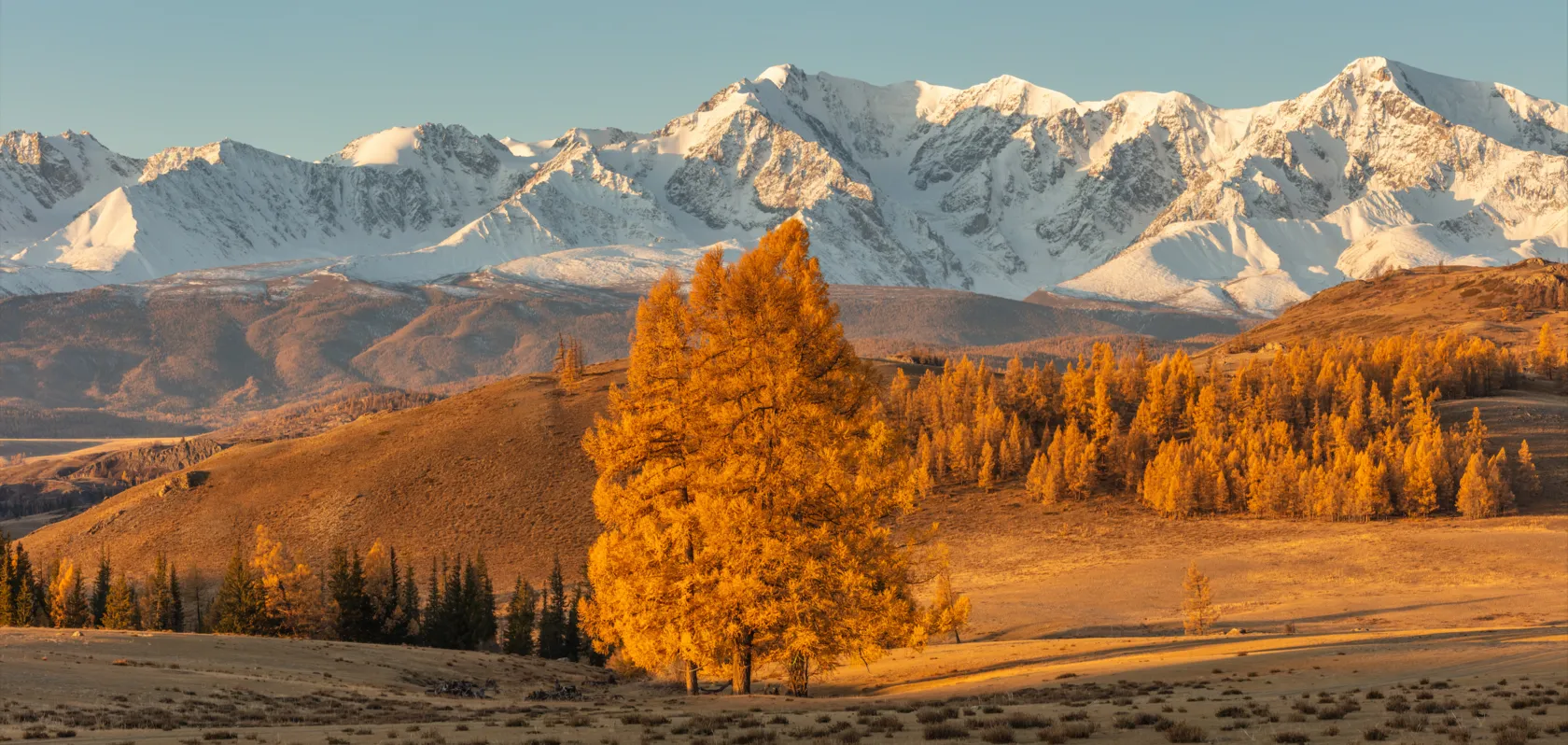
Autumn transforms the landscape gradually. Green foliage gives way to yellow, orange, red, and brown, often with several colors appearing in the same scene. The transition can look different from one day to the next and varies considerably by location and weather.
That makes fall an especially interesting season for photography. Instead of trying to capture only the peak of autumn, photograph the changes as they happen. Early-season images can emphasize isolated yellow leaves against green surroundings, while later scenes may be dominated by warm colors and fallen foliage.
Your camera may also record autumn colors differently from the way you remember them. Overcast conditions can make a scene look flatter, while strong backlight can produce intense highlights and deep shadows. During editing, subtle adjustments to exposure, contrast, white balance, and color can help bring the image closer to what you experienced.
If you are comparing editing workflows, you can also explore Luminar vs Lightroom to see how the two approaches differ.
Exclusive Tools of Endless Possibilities in One Editor
How to Plan a Trip to Photograph Fall Leaves
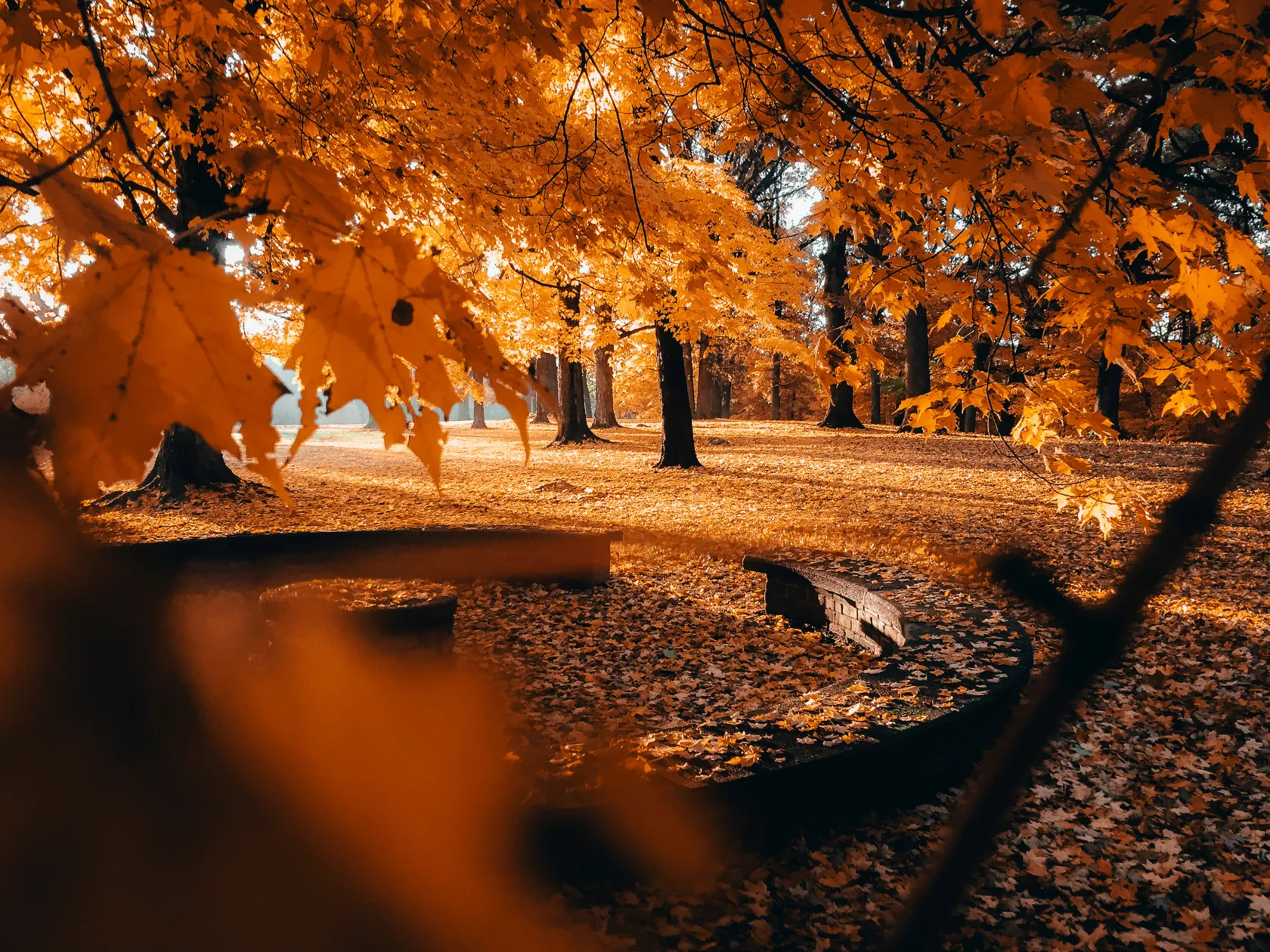
Good autumn photographs often depend as much on timing and location as on camera settings. Before heading out, check local foliage reports, recent photographs, weather forecasts, and conditions in the area you plan to visit.
You do not necessarily need to travel far. A nearby park, botanical garden, residential street, or wooded trail can provide plenty of opportunities if you pay attention to the light and composition.
Finding the Best Places to Photograph Fall Leaves
Look for locations that combine different colors, textures, and layers. A scene becomes more interesting when there is something to photograph in the foreground, middle ground, and background.
Good locations include:
- tree-lined streets with maples, birches, or other colorful trees;
- winding paths through parks or forests;
- lakes, ponds, and streams that create reflections;
- gardens with a mixture of trees and plants;
- old buildings surrounded by autumn foliage;
- hills or viewpoints that reveal layers of colorful trees.
Quiet locations are particularly useful because they give you time to explore different viewpoints instead of photographing the first composition you see.
When to Shoot the Peak of Color
There is no single date when autumn foliage reaches its peak everywhere. Timing depends on location, elevation, tree species, and weather conditions.
Instead of waiting for a specific calendar date, monitor the trees themselves. When you notice a mixture of changing leaves and strong remaining foliage, you may already have excellent photographic conditions.
It is also worth returning to the same location more than once. A familiar scene can look completely different after a week of changing colors and falling leaves.
Consider the Weather
Autumn weather can change the appearance of a scene dramatically.
After rain, wet leaves and tree trunks often appear darker and more saturated. Puddles can also create reflections that add another layer to the composition.
On cloudy days, soft, diffused light reduces harsh shadows and works particularly well for close-ups, portraits, and leaf textures.
In fog, distant trees can fade gradually into the background, creating depth and a quieter atmosphere.
On sunny days, direct light creates stronger contrast and can make backlit leaves glow. Look for areas where sunlight passes through foliage rather than photographing everything under direct midday sun.
Weather does not have to be ideal to produce good autumn photographs. Sometimes changing conditions are exactly what make a scene interesting.
Mastering Light and Composition
Autumn gives you plenty of color, but color alone does not automatically create a strong photograph. Pay attention to where the light falls, how elements are arranged, and where you want the viewer’s eye to travel.
Golden Hours vs. Cloudy Days
Early morning and late afternoon often provide warmer, lower-angle light. Backlit foliage can become particularly striking because sunlight passes through translucent leaves and reveals their veins and edges.
Cloudy weather offers a different advantage. The sky acts as a large diffuser, producing softer illumination and more even color. This can be ideal for photographing fallen leaves, bark, mushrooms, wet surfaces, and other small details.
Do not limit yourself to one type of light. Try photographing the same location under different conditions and compare how the mood changes.
Use Light Direction for More Vivid Photos
Light direction affects both color and depth.
- Front light can produce clear, bright colors with relatively even illumination.
- Side light emphasizes texture and gives leaves more dimensionality.
- Backlight can make translucent leaves glow and create bright edges around foliage.
Even moving a few steps to the left or right can completely change the way sunlight interacts with a leaf or tree.
For a simple detail shot, try holding a leaf between yourself and the light source. The illuminated veins can become a natural focal point.
Use Natural Layers and Leading Lines
Autumn landscapes are ideal for creating depth through layers. Fallen leaves can fill the foreground, trees or people can occupy the middle ground, and distant foliage, hills, or fog can form the background.
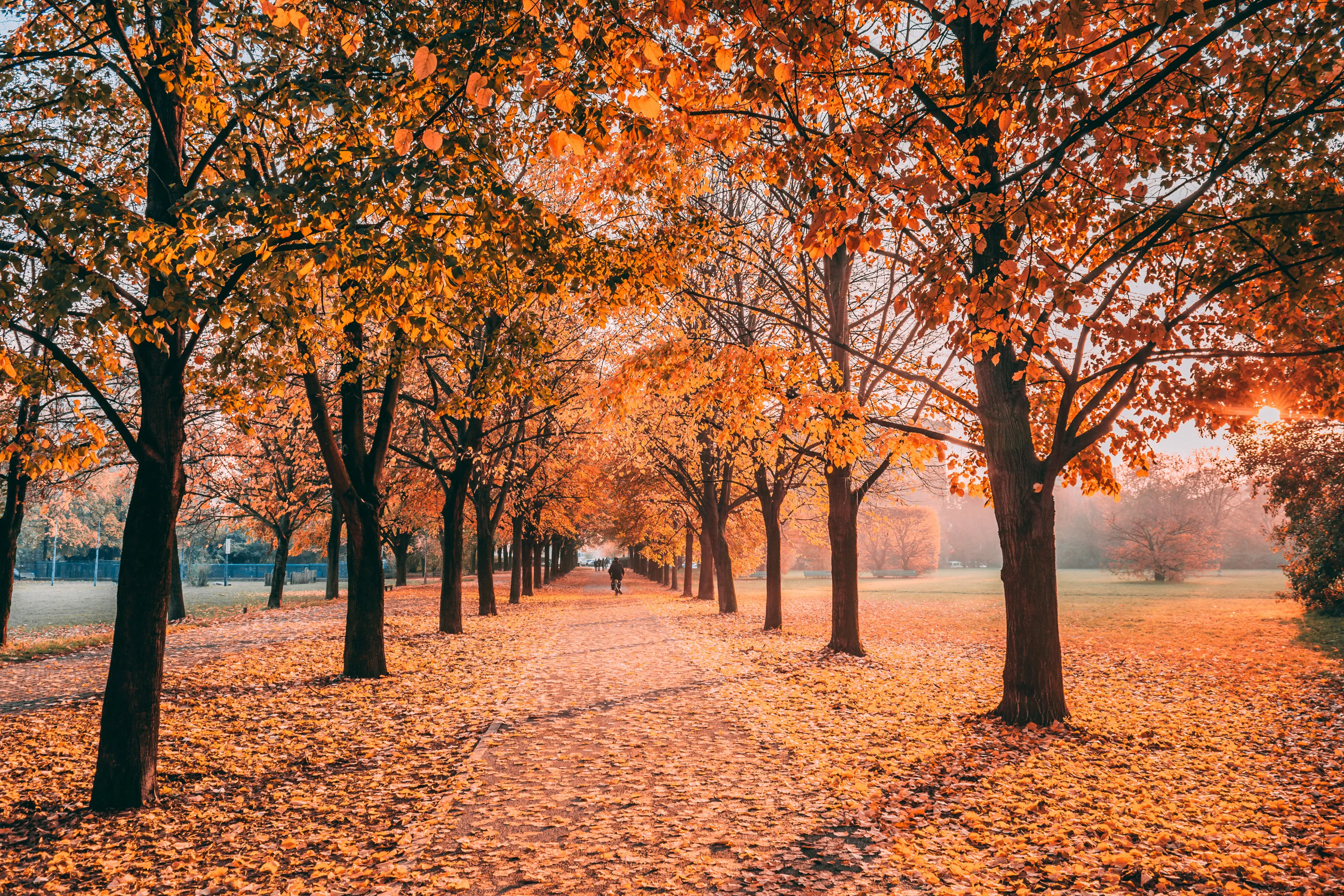
Leading lines can strengthen this effect. Paths, roads, fences, streams, rows of trees, and shadows can guide the viewer through the frame.
Try photographing from a low viewpoint to make foreground leaves more prominent and exaggerate the distance between different elements.
For additional control during editing, explore Luminar, which includes tools for adjusting light, color, detail, and composition.
Don’t Forget to Look Up
Autumn foliage can create completely different compositions above eye level.
Look upward for overlapping branches, patches of sky between leaves, patterns of color, and sunlight filtering through the canopy. A simple upward-facing composition can turn a collection of trees into an abstract pattern.
A blue sky provides strong color contrast, while a gray or cloudy sky can create a softer, more subdued background.
Experiment with the Textures and Patterns of Fall Leaves
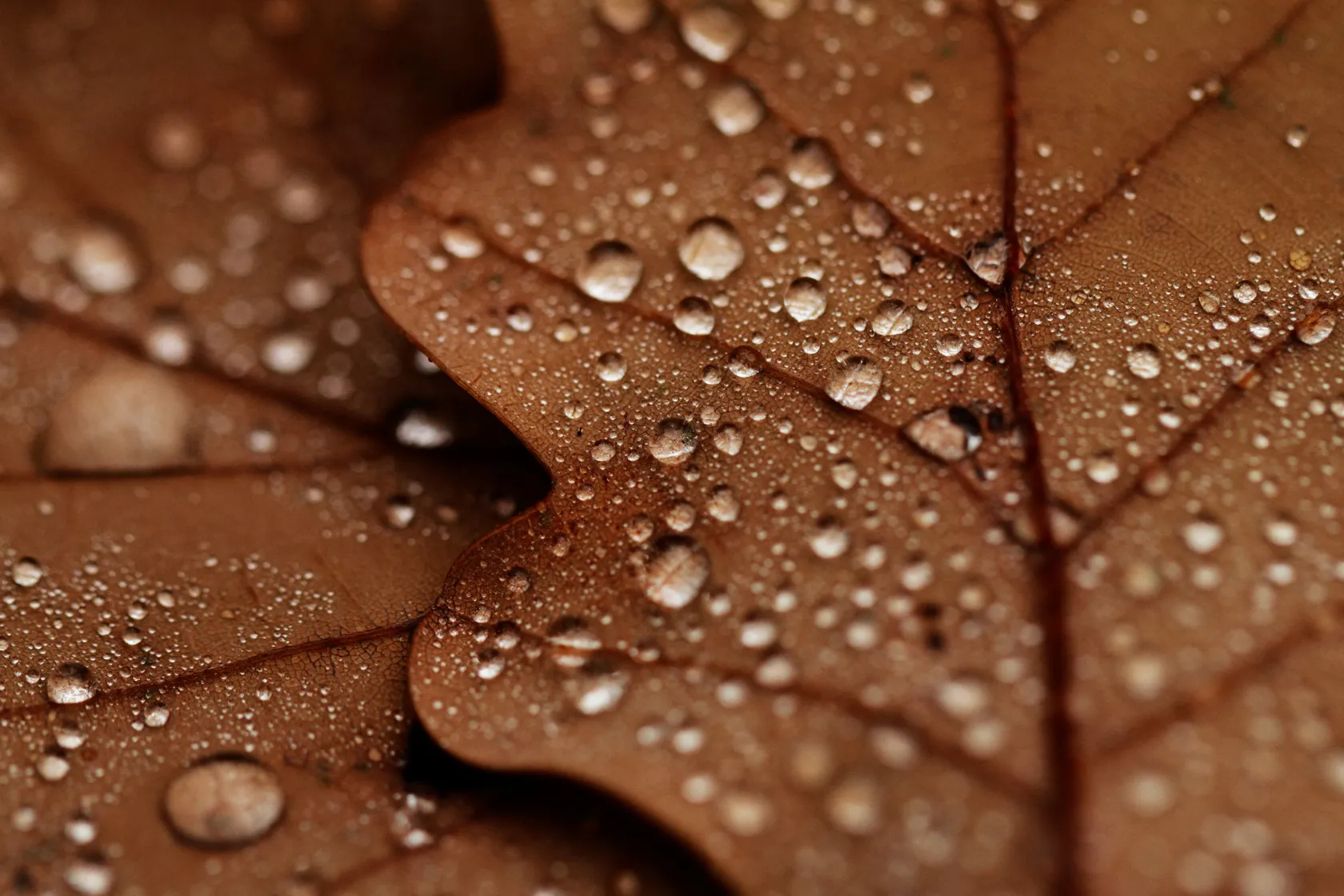
Leaves provide plenty of detail for close-up photography. Look for veins, tears, water droplets, curled edges, and overlapping shapes.
Instead of photographing a single leaf in isolation, try creating a frame filled with several leaves. Repetition of similar shapes can produce an almost abstract composition.
For detailed images, keep your background simple and pay attention to focus. A shallow depth of field can isolate one leaf, while a smaller aperture can keep several overlapping leaves sharp.
Technical Tips for Photographing Fall Foliage
Autumn often means lower light levels and rapidly changing conditions. Your settings should therefore respond to the scene rather than follow one fixed formula.
| Technique | How to use it |
| Use a polarizing filter | Reduce reflections and glare on wet leaves and water. Rotate the filter while looking through the viewfinder to find the desired effect. |
| Try long exposures | A tripod can help when using slower shutter speeds. Moving leaves or water can introduce controlled motion blur. |
| Experiment with intentional camera movement | During a longer exposure, move the camera vertically or horizontally to create an abstract, painterly effect. |
| Check focus and sharpness | Zoom in after shooting, especially when photographing individual leaves or fine textures. |
| Shoot RAW when possible | RAW files preserve more information for later adjustments to exposure, color, and highlights. |
A polarizing filter is especially useful near water, but remember that it can reduce the amount of light reaching the camera. You may need to adjust your shutter speed, aperture, or ISO accordingly.
For intentional camera movement, start with a slower shutter speed and experiment rather than treating a particular exposure time as a universal setting.
Elevate Your Photography with Our Advanced Software
Creative Ideas for Photographing Fall Leaves

You do not need a huge forest or dramatic mountain landscape to create memorable autumn images. Look for smaller scenes, unusual angles, and interactions between people, nature, and light.
1. Capture Reflections in Water
Puddles, ponds, lakes, and streams can mirror colorful trees and create symmetrical or abstract compositions.
Get close to the water and experiment with your camera height. A low viewpoint can make the reflection occupy most of the frame, while a higher viewpoint can reveal both the actual trees and their reflection.
After rain, look for temporary puddles in unexpected places. A small reflection on a sidewalk can sometimes create a more unusual photograph than a large lake.
2. Focus on Small Scenes
A single leaf can tell an autumn story just as effectively as an entire forest.
Photograph:
- dew or raindrops on leaves;
- colorful leaves against dark soil;
- clusters of overlapping foliage;
- textured bark;
- fallen leaves on steps or paths;
- mushrooms, berries, and other seasonal details.
Move closer and simplify the frame. If an unwanted object distracts from the subject, GenErase can help remove it during post-processing.
3. Photograph People and Pets to Create a Story
People and animals can add scale, movement, and emotion to autumn scenes.
Instead of arranging a formal pose, ask your subject to walk along a path, look through the trees, play with fallen leaves, or simply interact with the environment. Candid movement often feels more natural than a rigid pose.
Bright clothing can provide a strong color accent against muted foliage, while neutral clothing can keep the focus on the landscape.
Editing Fall Leaf Photos with Luminar
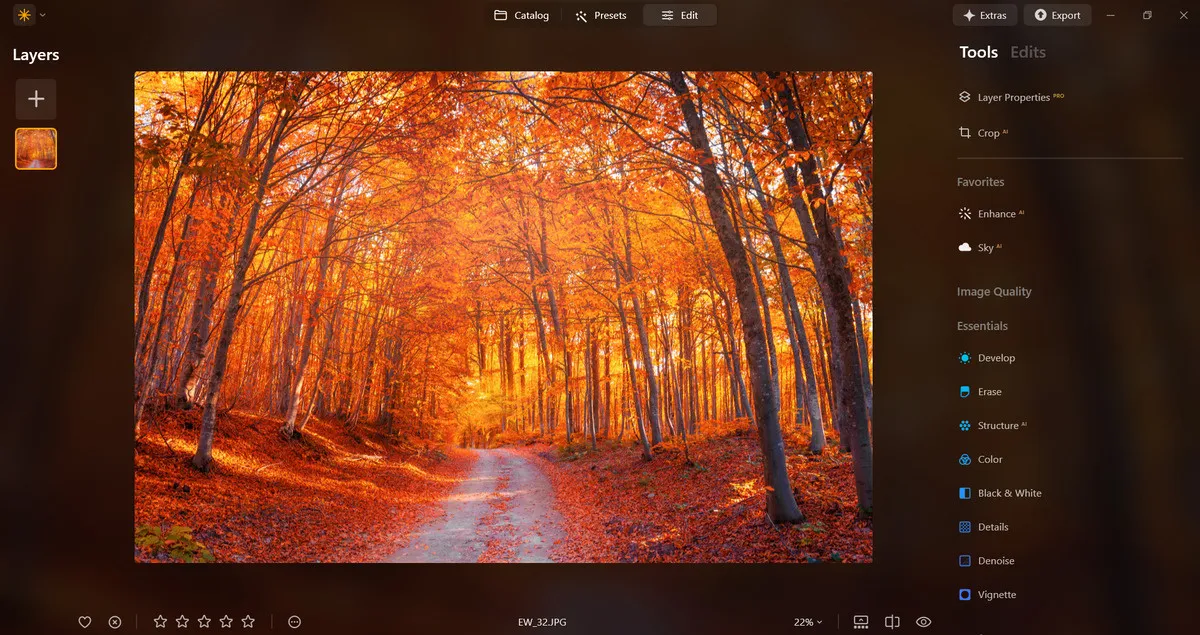 A camera does not always reproduce autumn colors exactly as they appeared in front of you. Editing can help correct exposure and color while preserving the character of the original scene.
When working on fall foliage, try the following approach:
1. Correct White Balance and Exposure
Start with the overall brightness and white balance before making stronger color adjustments. A slightly warmer white balance can emphasize the seasonal atmosphere, but avoid pushing warmth so far that neutral areas become noticeably orange.
Recover highlights when bright skies or sunlit leaves are too intense, and lift shadows when important details disappear into darkness.
2. Adjust Color Selectively
Autumn scenes already contain strong colors, so aggressive saturation can quickly make leaves look unnatural.
Instead, work selectively with individual color ranges. A small adjustment to yellows, oranges, or reds may be enough to separate foliage from its surroundings.
For a consistent look across a series of photographs, you can also explore photo filters and presets.
3. Enhance Detail Carefully
Leaves contain fine textures, but excessive sharpening or detail enhancement can make them look harsh.
Use detail adjustments selectively and inspect the image at 100% magnification. The goal is to emphasize natural texture without creating distracting halos or artificial edges.
4. Reduce Noise in Low-Light Photos
Early morning, late afternoon, and cloudy conditions can require higher ISO settings. If noise becomes distracting, Luminar’s Noiseless AI can help reduce it while preserving important details.
5. Remove Distracting Objects
A beautiful composition can be weakened by a bright sign, litter, stray branch, or other small distraction.
Tools such as GenErase can be useful for cleaning up minor distractions while keeping the main subject unchanged.
Your AI-Powered Photo Editor for MacOS and Windows
Common Fall Photography Mistakes
| Mistake | What to try instead |
| Oversaturating autumn colors | Make smaller, selective color adjustments. |
| Photographing only wide landscapes | Alternate wide scenes with close-ups and details. |
| Ignoring the background | Move your position or simplify distracting elements. |
| Shooting only in bright sunshine | Try cloudy weather, fog, or after-rain conditions. |
| Using one composition repeatedly | Change your height, focal length, and camera position. |
| Relying on a fixed camera setting | Adjust exposure and shutter speed to match changing light. |
| Ignoring fallen leaves | Use them as foreground elements, patterns, or subjects. |
A Simple Autumn Photography Exercise
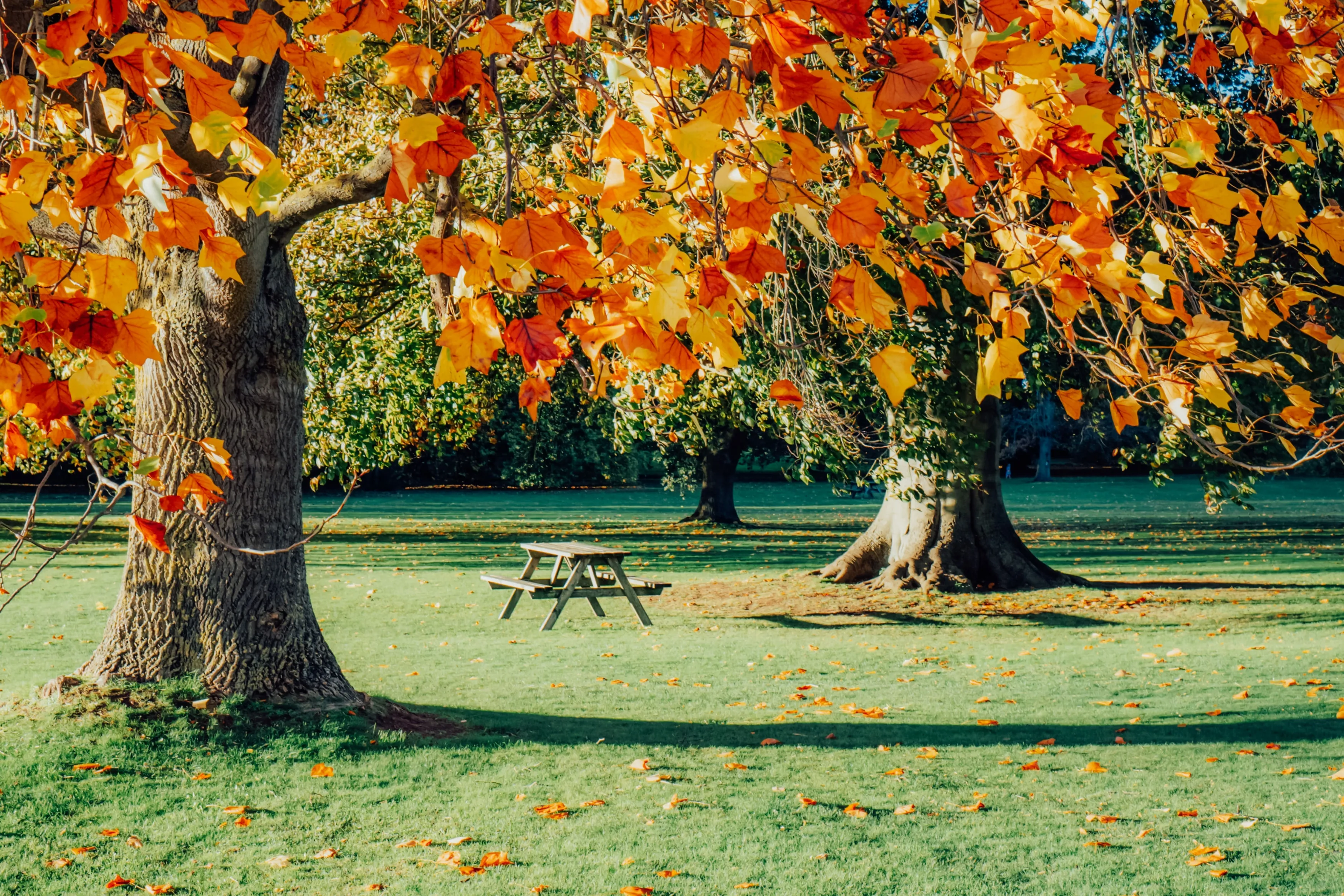
Choose one location and photograph it three different ways:
- Wide: capture the entire scene and its overall color palette.
- Medium: focus on a tree, path, person, or group of leaves.
- Close: photograph a single leaf, texture, reflection, or small detail.
Then return to the same location at a different time of day or in different weather.
This exercise shows how much variety can come from one place and helps develop your ability to recognize compositions instead of simply searching for picturesque locations.
Final Thoughts
Fall leaf photography is about more than capturing colorful trees. Autumn gives photographers an opportunity to work with changing light, reflections, texture, movement, and a constantly evolving palette.
Look beyond the obvious scenes. Photograph the first yellow leaf, the reflection in a puddle, the texture of wet bark, or a person walking beneath a canopy of trees. Try different viewpoints and weather conditions, and let the season change the way you approach a familiar location.
When you edit your photographs, keep the adjustments purposeful. Correct exposure, refine color, reduce distractions, and preserve the details that made the scene interesting in the first place.
The best autumn photograph may be waiting somewhere much closer than you expect.
FAQ
Early morning and late afternoon often provide warm, directional light, while cloudy days offer soft, even illumination that works well for foliage details.
There is no single ideal setting. Use a faster shutter speed for moving leaves, a lower ISO when light allows, and an aperture that provides the depth of field you need. A tripod can help in low light.
Yes. Cloudy conditions reduce harsh shadows and can make leaf colors and textures easier to photograph. Rain and fog can also create distinctive autumn scenes.
Start with white balance and exposure, then make moderate, selective color adjustments. Avoid pushing saturation too far, especially in reds, oranges, and yellows.
Absolutely. Smartphones work well for close-ups, reflections, patterns, and well-lit landscapes. Tap to control focus and exposure, and try different angles instead of relying only on the default viewpoint.