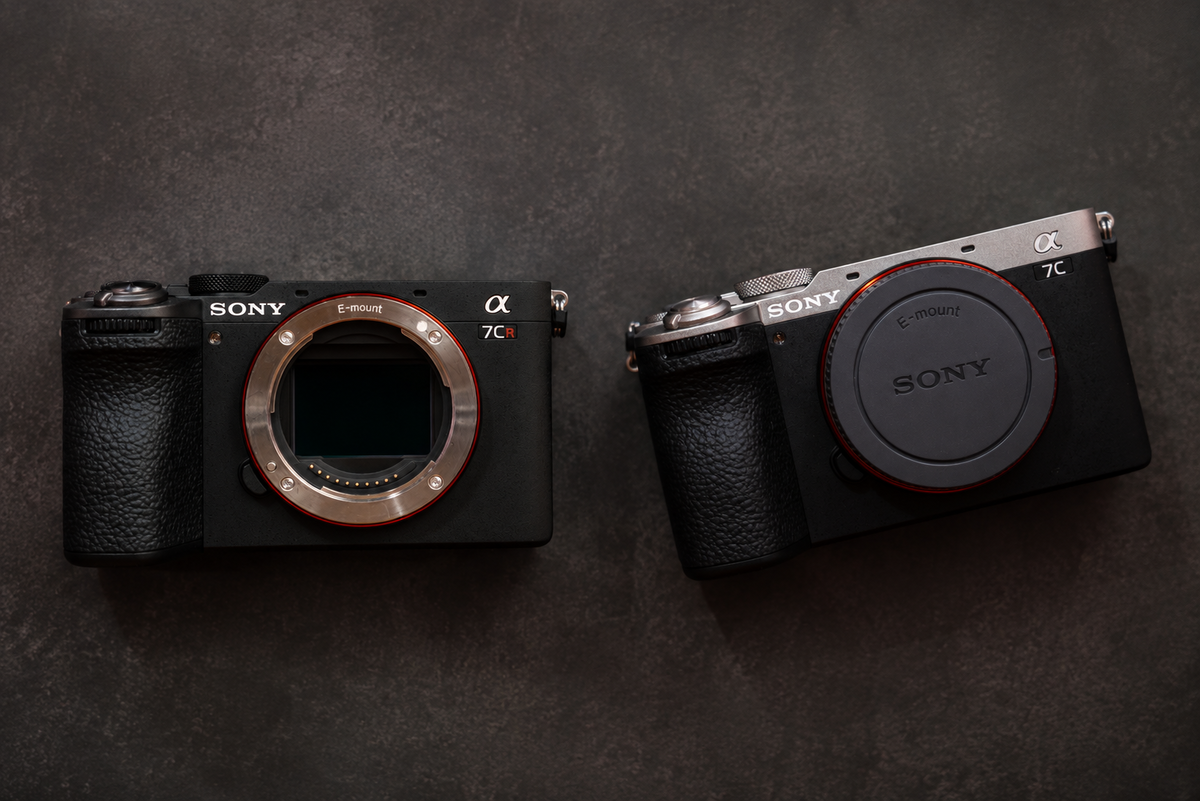
In this Sony A7CR vs A7C II guide, I compare both cameras in real-world shooting situations to see which one offers the better overall experience.
If you’re trying to decide between Sony’s two compact full-frame cameras, my Sony A7CR vs A7C II comparison will help you understand where each model excels and which one makes more sense for your workflow.
On paper, the A7C II and A7CR seem like minor variations of the same camera. But after carrying them around, editing their files, and shooting in different conditions, I found that they are aimed at rather different types of photographers.
Key Takeaways
The A7CR uses a 61MP sensor, while the A7C II features a more practical 33MP sensor.
Both cameras share Sony’s latest AI-assisted autofocus system.
The A7C II generally delivers better workflow efficiency due to smaller file sizes.
The A7CR offers significantly more cropping flexibility for landscape and commercial work.
Battery life and portability are nearly identical between the two models.
Sony A7C II and A7CR in 30 Seconds
Category
Sony A7C II
Sony A7CR
Resolution
33MP
61MP
Best For
Hybrid shooters
Landscape and studio photographers
File Sizes
More manageable
Significantly larger
Continuous Shooting
Better buffer performance
More demanding workflow
Overall Value
Excellent
More specialized
Quick Verdict
Better choice for most photographers
Ideal for users who genuinely need extremely high resolution
How I Tested These Cameras
Rather than simply comparing the published specifications, I tested both cameras in real-world shooting scenarios.
My testing focused on:
Dynamic range and detail retention
Autofocus reliability
Handling compact and larger lenses
Buffer performance
Low-light results
File management and editing flexibility
Long shooting sessions and travel usability
Exclusive Tools of Endless Possibilities in One Editor
Following its 2023 release, Sony expanded the A7C lineup in two directions. The A7C II became the natural replacement for the original model, while the A7CR brought flagship-level resolution and processing power to an unusually compact full-frame body.
The A7C II vs A7CR debate is therefore less about appearance and more about how resolution, file sizes, and workflow priorities affect everyday use.
Design and Build Quality Differences
From a physical standpoint, the two cameras are almost similar. The A7C II weighs 514g, while the A7CR weighs 515g, and both have the same small body size of 124 x 71 x 63 mm, along with a magnesium alloy body that resists all weather conditions. Both camera types come with a 2.36-million-dot EVF, a 3-inch full-tilt LCD, and a 1 UHS-II SD card slot.
Nevertheless, the A7CR features a grip extension in the box that can be removed, and that greatly enhances handling when using heavy lenses like FE 24-70mm F2.8 GM II and 70-200mm F4 G. Both cameras remain exceptionally portable and are noticeably smaller in size than models such as A7 IV or A7R V.
For photographers who frequently edit landscape or travel images afterward, software that can help add filters to photos can further expand creative possibilities when working with Sony’s highly flexible RAW files.
Key Features Comparison
Although the bodies look similar, sensor performance is where the cameras begin to diverge.
Image Performance
The biggest difference between the A7C II and the A7CR is resolution. The A7C II uses a 33MP backside-illuminated full-frame sensor. At the same time, the A7CR features Sony’s 61MP sensor borrowed from the A7R V. Looking purely at the specs, the cameras appear relatively similar, but their sensors cater to different types of photographers.
Key sensor differences:
Sony A7C II: 33MP (7008 × 4672)
Sony A7CR: 61MP (9504 × 6336)
Base ISO: 100 on both cameras
Dynamic range: excellent on both cameras, with independent testing placing both around 14 stops at base ISO
RAW file size: approximately 35-40MB on the A7C II and 60-70MB for compressed RAW files on the A7CR, with uncompressed files exceeding 120MB
In reality, the 61MP sensor in the A7CR offers greater cropping flexibility and allows for larger prints. Still, larger RAW images will require more disk space and more computer power to edit.
For most photographers, the A7C II’s 33MP sensor is already more than sufficient for portraits, travel, events, and commercial work. The A7CR is designed for those working with landscapes, products, or architecture.
Both cameras offer excellent dynamic range, although the A7CR retains slightly finer detail at lower ISO settings.
Autofocus and Shooting Speed
Both cameras use Sony’s dedicated AI processing unit and support subject recognition for humans, animals, birds, insects, cars, trains, and airplanes. Autofocus performance is nearly identical, with highly reliable eye detection and subject tracking in both photo and video modes.
While both the A7C II and A7CR can shoot at a maximum of 10 fps with AF/AE tracking, the A7C II generally feels more responsive during extended bursts because its smaller files clear the buffer faster. For instance, A7CII has a 33MP resolution, while A7CR has a 61MP resolution. Files in compressed RAW format for A7CR may exceed 60 MB.
As a result, the A7CR vs A7CII decision comes down less to autofocus capabilities and more to whether you prioritize workflow efficiency or maximum resolution.
Elevate Your Photography with Our Advanced Software
Battery life is nearly identical, as both cameras use Sony’s NP-FZ100 battery.
Battery ratings (CIPA):
Sony A7C II: up to 540 shots with the LCD and 510 shots with the EVF
Sony A7CR: up to 530 shots with the LCD and 500 shots with the EVF
Portability highlights:
Dimensions: 124 × 71 × 63 mm (both cameras)
Weight: 514g (A7C II) vs 515g (A7CR)
Significantly smaller than cameras like the Sony A7 IV or A7R V
In reality, both cameras are extremely portable and offer one of the best combinations of portability and full-frame image quality currently available. Their small size makes them quite desirable for travel photographers and content creators.
User Interface and Controls
The improved interface and control options make using the camera easier. The new menu system is much more user-friendly than that of older Sony cameras. The addition of the front command dial also improves the manual shooting experience.
During testing, I found both cameras enjoyable and intuitive to use. The learning curve is relatively gentle, particularly for people who are familiar with Sony equipment. Portrait photographers working with the highly detailed files produced by the A7CR may also appreciate software that helps retouch photos more efficiently during post-processing.
Pricing and Value for Money
The price for the Sony A7C II launched at approximately $2,200 body only, while the A7CR debuted at around $3,000.
As of mid-2026, I found that average street prices have become more attractive:
Sony A7C II: approximately $2,100-$2,200 body only
Sony A7CR: approximately $2,800-$3,000 body only
Choose the Sony A7C II if you:
Want the best overall value for money
Prefer smaller RAW files and a faster workflow
Primarily shoot travel, events, portraits, or everyday photography
Choose the Sony A7CR if you:
Frequently crop images heavily
Print large-format photos
Shoot landscapes, commercial work, or studio projects that benefit from maximum resolution
For most photographers, it will ultimately be a matter of workflow versus camera capabilities. While the A7CR is a fantastic piece of technology on paper, the A7C II comes out on top for its combination of picture quality and portability.
Your AI-Powered Photo Editor for MacOS and Windows
What surprised me most during testing was how similar these cameras felt in day-to-day shooting. The A7C II already delivers more than enough resolution for most situations and is easier to work with thanks to its smaller files.
The A7CR certainly has its place, but its advantages are most noticeable to photographers who frequently crop heavily or produce large prints.
Subscribe to know first
Our delivery owl will bring you our best deals and news about Skylum news.